
The new income tax rules 2026 represent the most significant overhaul of India’s personal tax system in over six decades. Starting April 1, 2026, the new Income Tax Act, 2025, officially replaced the Income Tax Act of 1961, bringing revised tax slabs, updated TDS rules, and simplified compliance requirements for salaried employees across the country.
Whether you are a government employee, a private sector professional, or a young earner just starting your career, these changes directly affect how much tax you pay, what you can claim, and how your employer deducts TDS from your salary every month.
In this guide, we break down every major update under the new income tax rules 2026 that applies to salaried individuals, explain what changed from the previous regime, and tell you exactly what steps to take right now.
Why Did the New Income Tax Rules 2026 Come Into Effect?
Two parallel forces are driving this change.
First, the Income Tax Act of 1961 had accumulated over six decades of amendments, exemptions, and legal additions that made compliance unnecessarily complex. As a result, the government introduced a completely rewritten Income Tax Act, 2025, to replace it. The new law took effect on April 1, 2026, the start of Assessment Year 2026-27.
Second, the government’s stated goal under the new income tax rules 2026 is simpler compliance, higher take-home pay for middle-income earners, and a strong push toward the new tax regime. Consequently, the new rules revise tax slabs significantly and reduce tax liability for those earning up to Rs 12 lakh per year.
Additionally, the government has restructured how employers handle TDS, how Form 16 is generated, and how deductions are documented, all to reduce paperwork for salaried taxpayers.
Overview: What Actually Changed After April 1, 2026
Before diving into the details, here is a quick summary of the changes that specifically took effect with the new Income Tax Act, 2025, from April 1, 2026:
| Change Area | What Changed | Who Is Affected |
|---|---|---|
| Tax slabs (new regime) | Revised significantly; effective zero tax up to Rs 12 lakh | All salaried taxpayers |
| NPS employer contribution | Deduction limit raised to 14% of basic salary for private sector | Private sector NPS employees |
| TDS threshold on interest | Raised from Rs 40,000 to Rs 50,000 | Employees with FD or savings income |
| Income Tax Act replaced | New Income Tax Act, 2025 replaces the 1961 Act entirely | All taxpayers |
| Section 80C deductions | Not available under the new default regime | Those on old regime considering switching |
| HRA exemption | Not available under the new default regime | Employees in rented accommodation |
Now let us break down each change in detail.
1. Revised Tax Slabs Under the New Income Tax Rules 2026
The most widely discussed part of the new income tax rules 2026 is the revised slab structure under the new regime. For Financial Year 2025-26 (Assessment Year 2026-27), the slabs are as follows:
| Annual Taxable Income | Tax Rate (New Regime) |
|---|---|
| Up to Rs 4,00,000 | Nil |
| Rs 4,00,001 to Rs 8,00,000 | 5% |
| Rs 8,00,001 to Rs 12,00,000 | 10% |
| Rs 12,00,001 to Rs 16,00,000 | 15% |
| Rs 16,00,001 to Rs 20,00,000 | 20% |
| Rs 20,00,001 to Rs 24,00,000 | 25% |
| Above Rs 24,00,000 | 30% |
These revised slabs are a direct result of the new Income Tax Act, 2025. For most salaried employees earning between Rs 7 lakh and Rs 15 lakh, the new slabs result in meaningfully lower tax outgo compared to the previous slab structure.
New Regime vs Old Regime: Which One Should You Choose?
The answer depends on your total claimed deductions. As a general rule, if your deductions under the old regime (Section 80C, HRA, home loan interest, etc.) exceed Rs 3.75 lakh in total, the old regime may still save you more tax. On the other hand, if your deductions fall below that threshold, the new regime will likely result in lower overall liability.
Furthermore, the new regime offers lower rates and significantly less documentation. It has been the default regime since FY 2023-24, and with the new Act now fully in force, most employers are applying it more strictly than before.
2. How Zero Tax Up to Rs 12 Lakh Works Under the New Regime
One of the most important things to understand about the new income tax rules 2026 is how the zero tax threshold works in practice. While the Section 87A rebate and the standard deduction were introduced in earlier budgets, the newly revised slabs under the Income Tax Act, 2025, now combine with these existing benefits to produce a significantly lower effective tax burden.
Here is how it works for a salaried employee earning Rs 12,75,000 per year:
| Step | Amount |
|---|---|
| Gross salary | Rs 12,75,000 |
| Less: Standard deduction | Rs 75,000 |
| Taxable income | Rs 12,00,000 |
| Tax on Rs 12,00,000 (as per new slabs) | Rs 60,000 |
| Less: Section 87A rebate | Rs 60,000 |
| Final tax payable | Zero |
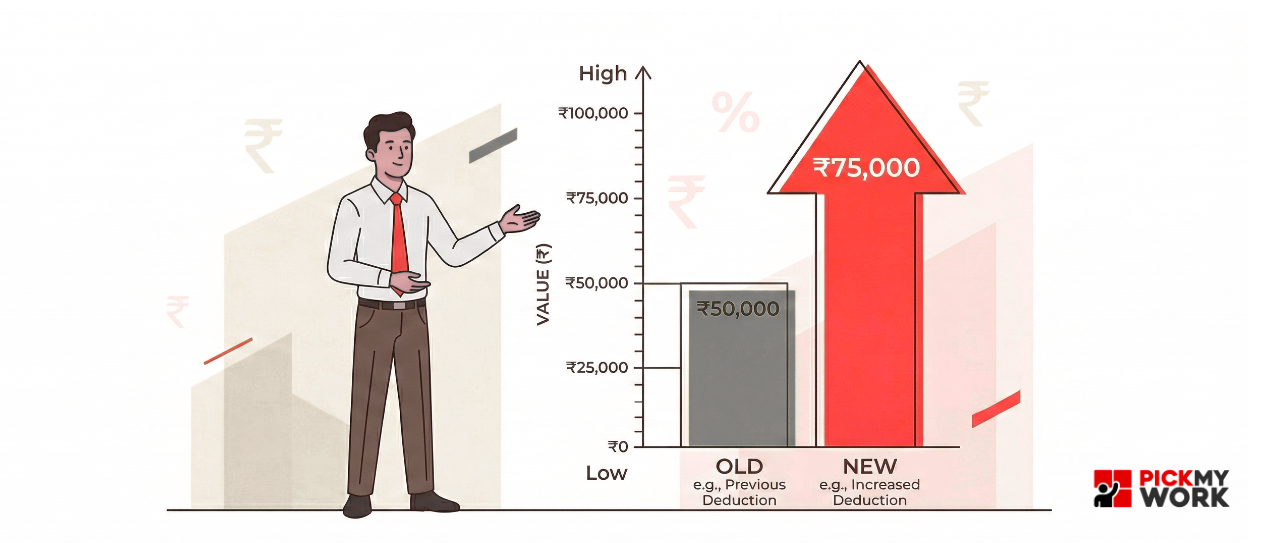
Important clarification: This applies only to regular salary income. Special rate income such as capital gains from equity or mutual funds does not qualify for the Section 87A rebate, even if total income is below Rs 12 lakh.
3. NPS Employer Contribution Deduction Raised to 14%
This is a genuine April 2026 change for private sector employees. Under the new income tax rules 2026, private sector salaried employees enrolled in the National Pension System (NPS) benefit from a higher deduction on their employer’s contribution. The limit has been raised from 10% to 14% of basic salary plus dearness allowance.
This brings private sector employees on par with central government employees, who already enjoyed the 14% limit. Moreover, this deduction is available under the new regime, making it one of the few meaningful tax-saving tools that works within the new default framework.
For example, if your basic salary is Rs 6 lakh per year, your employer’s NPS contribution of up to Rs 84,000 (14%) is now fully deductible from your taxable income. This can lead to meaningful savings, especially for those in the 20% or higher tax brackets.
4. TDS on Salary: What Your Employer Is Doing Right Now
The new regime has been the default tax regime since FY 2023-24. However, with the new Income Tax Act, 2025, now fully in force from April 2026, employers are applying this more strictly than before. If you have not submitted a written declaration to your HR team choosing the old regime, your TDS is being deducted under the new regime right now, from your very first April payslip.
What Salaried Employees Must Do About TDS
If you want TDS deducted under the old regime instead, submit a written declaration to your HR or payroll team as soon as possible. If TDS has already been deducted under the new regime and you later file your ITR under the old regime, you can claim the difference as a refund. However, it is cleaner and simpler to declare your preference at the start of the year.
Additionally, if you change your preference mid-year, the adjustment happens at the time of ITR filing and not through your employer during the year itself.
5. Deductions Not Available Under the New Default Regime
Under the new income tax rules 2026, the new regime remains the default. This comes with a trade-off that every salaried employee must understand: most popular deductions and exemptions are not claimable under the new regime. If you are considering switching from the old regime or are unsure which applies to you, here is what you give up under the new default:
- Section 80C deductions. Investments in PPF, ELSS, LIC premiums, home loan principal, and tuition fees cannot be deducted under the new regime.
- HRA exemption. House Rent Allowance is fully taxable under the new regime. Therefore, employees paying high rent in metro cities should evaluate whether the old regime serves them better.
- Leave Travel Allowance. LTA exemptions are not available under the new regime.
- Section 24(b) home loan interest. Interest paid on a home loan for a self-occupied property cannot be deducted.
- Professional tax deduction. The deduction for professional tax deducted by employers is also unavailable under the new default.
In short, employees with significant deduction-linked investments and high HRA may still find the old regime more beneficial despite its higher slab rates. Only you can make that comparison accurately based on your own numbers.
6. TDS Threshold on Interest Income Raised
Many salaried employees also earn interest from savings accounts, fixed deposits, or recurring deposits. Under the new income tax rules 2026, the TDS threshold on interest earned from banks and post offices has been raised from Rs 40,000 to Rs 50,000 for non-senior citizens.
Furthermore, for senior citizens, the threshold has moved from Rs 50,000 to Rs 1 lakh. As a result, fewer salaried individuals will have TDS deducted at source on their interest income, improving monthly cash flow.
However, this does not mean the interest becomes tax-free. If your total income exceeds the basic exemption limit, interest income remains taxable, and you must declare it in your ITR even if no TDS was deducted.
New Income Tax Rules 2026: Before and After April 1, 2026
Here is a clear comparison of the key numbers that specifically changed on or after April 1, 2026, under the new Income Tax Act, 2025:
| Parameter | Before April 2026 | After April 2026 |
|---|---|---|
| Tax-free income limit (new regime) | Up to Rs 7 lakh (with rebate) | Up to Rs 12 lakh (with rebate) |
| NPS employer deduction (private sector) | Up to 10% of basic salary | Up to 14% of basic salary |
| TDS threshold on bank interest | Rs 40,000 | Rs 50,000 |
| Income Tax Act in force | Income Tax Act, 1961 | Income Tax Act, 2025 |
5 Action Steps After the New Income Tax Rules 2026
- Check how your employer is currently deducting TDS. Since the new regime is the default and is now being applied more strictly, verify with your HR team which regime your TDS is being calculated under. If you want the old regime, submit a written declaration immediately.
- Calculate your actual deductions before choosing a regime. Add up your Section 80C investments, HRA, home loan interest, and any other old-regime deductions. If the total exceeds Rs 3.75 lakh, the old regime may save you more. Otherwise, the new regime is likely the better option.
- Check whether your employer’s NPS contribution reflects the new 14% limit. If your company contributes to NPS on your behalf, confirm with HR that the updated 14% rate is being applied and reflected correctly in your salary structure and Form 16.
- Submit your investment declarations to your employer early. Submit your estimated investment proofs at the start of the year rather than waiting until January. As a result, TDS will be spread evenly across 12 months instead of spiking in the final quarter.
- Review your credit card spending alongside your tax filing. Under the related credit card rules change from April 2026, high-spending cardholders now have their transactions reported to the Income Tax Department. Consequently, make sure your declared income aligns with your actual spending patterns to avoid any scrutiny.
Earn Extra Income While You Navigate the New Income Tax Rules 2026
Understanding tax rules is important. However, building additional income streams matters just as much. With PickMyWork, salaried professionals can take on flexible, part-time earning tasks that fit around their office hours, with no investment required.
Here is how it works:
- Download the PickMyWork app
- Sign up with your mobile number (free, no investment needed)
- Browse tasks in banking, credit cards, insurance, and more
- Earn incentives for every successful activation you complete
Perfect for: salaried employees, working professionals, and anyone looking to supplement their monthly income on a flexible schedule.
Related Reads on PickMyWork
- Credit Card Rules Change April 2026: What Every Cardholder Must Know
- Best UPI Credit Cards in India 2026
- Best Credit Cards for Insurance Payments India 2026
- HDFC Regalia Gold Credit Card: Premium Rewards for the Smart Spender
- Top 10 Banks in India by Market Cap
- Best Travel Credit Cards India 2026
- Online Work and Earn Money in India
Frequently Asked Questions
- What is the biggest change in the new income tax rules 2026 for salaried employees?
The most impactful change is the revised tax slab structure under the new regime, which effectively results in zero tax for those earning up to Rs 12,75,000 per year after applying the standard deduction. Combined with the NPS employer deduction being raised to 14% and the TDS threshold on interest rising to Rs 50,000, these changes meaningfully reduce the tax burden for most salaried employees. - Will I pay zero tax if my salary is Rs 12,75,000?
Yes, in most cases. After applying the Rs 75,000 standard deduction, your taxable income drops to Rs 12,00,000. The tax on this under the new slabs is Rs 60,000, which is fully covered by the Section 87A rebate. However, this applies only to regular salary income and not to special rate income like capital gains. - Can I still claim Section 80C deductions in 2026?
Yes, but only if you opt for the old regime. Section 80C deductions including PPF, ELSS, LIC premiums, and home loan principal are not available under the new default regime. Choose the old regime if your total deductions exceed Rs 3.75 lakh annually. - Does the new income tax rules 2026 affect my HRA exemption?
HRA is not exempt under the new default regime. If you pay significant rent in a metro city, calculate whether the HRA exemption under the old regime outweighs the benefit of the lower slab rates under the new regime before deciding. - How does the NPS deduction change affect private sector employees?
Private sector employees can now claim a deduction on their employer’s NPS contribution up to 14% of basic salary, up from 10% earlier. This deduction is available under the new default regime, making it one of the most valuable tax-saving tools for salaried professionals in 2026. - My employer has not asked me to declare my tax regime. What should I do?
Do not wait. Since the new regime is the default and is being applied strictly from April 2026, your employer is almost certainly deducting TDS under it already. If you want to be taxed under the old regime, submit a written declaration to your HR or payroll team as soon as possible. - Will the new income tax rules 2026 affect my interest income from FDs?
Yes, positively. The TDS threshold on bank and post office interest has been raised from Rs 40,000 to Rs 50,000 for non-senior citizens. This means fewer people will have TDS deducted at source on their FD interest. However, the interest remains taxable and must be declared in your ITR if your total income exceeds the basic exemption limit. - Where can I find the full text of the new Income Tax Act, 2025?
The new Income Tax Act, 2025, is available on the official Income Tax India website at incometax.gov.in. Additionally, the CBDT publishes circulars clarifying specific provisions for salaried taxpayers on the same portal.