
The biggest credit card rules change in years has arrived. Starting April 1, 2026, a wave of regulatory updates from the RBI and Income Tax Department, combined with major reward restructuring by banks like HDFC, SBI, ICICI, and Axis, means that almost every cardholder in India now faces new rules.
Whether you use your credit card for groceries, rent, insurance premiums, travel bookings, or online shopping, this credit card rules change affects how you transact, earn rewards, and manage your finances.
In this guide, we break down every major credit card rules change for April 2026, explain who each one impacts, and tell you exactly what steps to take right now.
Why Did This Credit Card Rules Change Happen in April 2026?
Two parallel forces are driving this credit card rules change.
First, on the regulatory side, the RBI and the Central Board of Direct Taxes (CBDT) are pushing for stronger transaction security, better tax transparency, and faster credit score updates. As a result, the new Income Tax Act, 2025, which officially replaced the six-decade-old 1961 Act on April 1, 2026, forms the backbone of several tax-related updates.
Second, on the banking side, the economics of unlimited reward programmes are no longer sustainable. Consequently, banks are now tying perks like lounge access, cashback, and reward points to actual spending behavior rather than simply holding a card.
In other words, if your income, spending, and repayments are well-aligned, the regulatory changes will mostly run in the background. However, the reward and fee changes from banks will hit your wallet immediately.
Overview: 9 Major Credit Card Rules Change from April 2026
Before we dive into the details, here is a quick overview of every credit card rules change that took effect this month:
| Rule Change | Driven By | Who Is Affected |
|---|---|---|
| Mandatory 2FA for all digital payments | RBI | All card users (online + POS) |
| Spending above Rs 10L reported to IT Dept | Income Tax Act, 2025 | High-spending cardholders |
| PAN mandatory for new card applications | RBI / CBDT | New applicants |
| Weekly credit bureau reporting (7-day cycle) | RBI | All borrowers and cardholders |
| Corporate card personal spending = taxable | Income Tax Act, 2025 | Employees with company-issued cards |
| Credit card statement as PAN address proof | CBDT | PAN applicants |
| Income tax payable via credit card | Income Tax Act, 2025 | All taxpayers |
| Reward rate cuts and lounge access restrictions | Banks (HDFC, SBI, ICICI, etc.) | Cardholders of specific cards |
| New fees on rent, gaming, and wallet loading | Banks (ICICI, Yes Bank, etc.) | Users in those spending categories |
Now let’s break down each credit card rules change in detail.
1. RBI’s Mandatory Two-Factor Authentication (2FA)
Starting April 1, 2026, every digital payment in India must go through at least two independent authentication factors. This applies to credit cards, debit cards, UPI, and wallets alike, covering both online and point-of-sale transactions.
The RBI’s Authentication Mechanisms for Digital Payment Transactions Directions, 2025, specifically requires that at least one of the two factors must be dynamically generated. In simple terms, this means it must be unique to that specific transaction.
What Are the Two Authentication Factors in This Credit Card Rules Change?
The RBI now requires authentication from at least two of these three categories:
| Factor Type | What It Means | Examples |
|---|---|---|
| Knowledge | Something only you know | PIN, password, passphrase |
| Possession | Something only you have | Phone, card, OTP, software token |
| Inherence | Something you are | Fingerprint, face scan, Aadhaar biometric |
OTPs still qualify as one factor. However, they can no longer serve as the sole line of defense. Instead, banks can now use biometrics, device-based tokens, or app-native prompts alongside OTPs.
Will 2FA Slow Down Your Transactions?
Not significantly. The RBI has encouraged risk-based authentication. As a result, small, routine payments from a trusted device will go through with minimal friction. Only high-value or unusual transactions will trigger the full multi-step verification process.
Additionally, the RBI plans to extend similar authentication norms to international card-not-present transactions by October 2026.
2. Stricter Tax Reporting on High-Value Spending
Under the new Income Tax Act, 2025 (effective April 1, 2026), this credit card rules change links your spending more tightly to your tax identity through the Statement of Financial Transactions (SFT) framework.
Here is what triggers reporting to the Income Tax Department:
| Transaction Type | Reporting Threshold | Reported By |
|---|---|---|
| Non-cash credit card payments (annual total) | Rs 10 lakh or more | Bank / card issuer |
| Cash payments toward credit card bills | Rs 1 lakh or more | Bank / card issuer |
| Overseas credit card spending | Above specified thresholds | Bank / card issuer |
While these reporting norms existed in some form earlier, enforcement under the new framework will be far more consistent.
Important clarification: This credit card rules change does NOT create a new tax on spending. It is purely a reporting mechanism. Therefore, you will not owe additional tax simply for spending above Rs 10 lakh. However, the data may be cross-referenced with your income tax return, and significant mismatches between declared income and actual spending could attract scrutiny.
3. PAN Now Mandatory for New Applications
From April 1, 2026, no bank or NBFC will process a new credit card application without a valid Permanent Account Number (PAN). In addition, updated application forms now require date-of-birth verification alongside Aadhaar.
As a result, this credit card rules change ties every new card directly to a verified financial identity. Consequently, it becomes harder to open fraudulent or duplicate accounts.
For most existing cardholders who already have PAN-linked cards, this changes nothing. However, if you have cards that are not linked to your PAN, expect your issuer to reach out for compliance.
Bonus: Credit Card Statement Now Valid as PAN Address Proof
Credit card statements issued within the last three months can now serve as valid proof of address for PAN applications. This simplifies documentation for people who may not have utility bills or rental agreements available.
4. Weekly Credit Bureau Reporting
This credit card rules change is one that many people may overlook, but it matters significantly for your credit score.
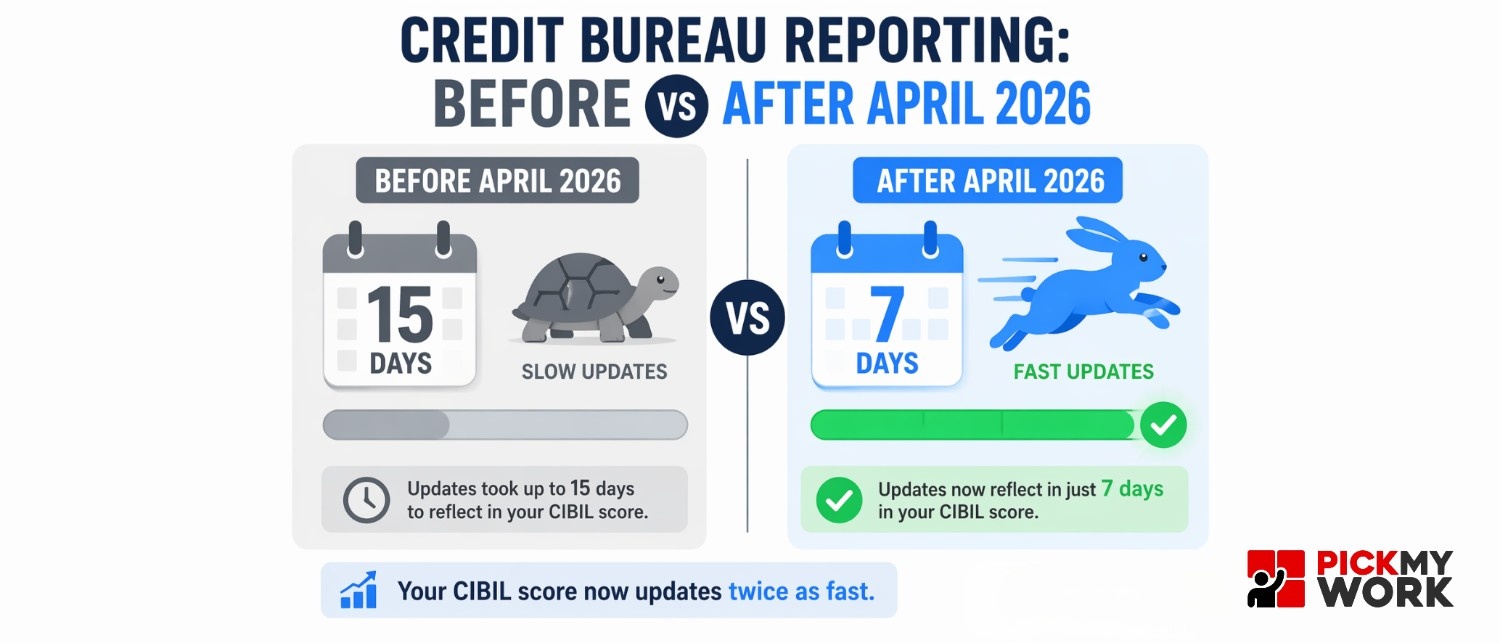
From April 1, 2026, banks and NBFCs must report borrower data to credit information companies (like CIBIL, Experian, and Equifax) every 7 days. Previously, the reporting cycle ran every 15 days.
Time for timely payment to reflect on scoreUp to 15-30 daysWithin 7-14 days
| Parameter | Before April 2026 | After April 2026 |
|---|---|---|
| Reporting frequency to credit bureaus | Every 15 days | Every 7 days |
| Time for missed payment to reflect on score | Up to 15-30 days | Within 7-14 days |
This is essentially a double-edged sword. On one hand, if you repay on time, your credit score will improve faster. On the other hand, if you miss a payment or default, the damage to your CIBIL score will also show up much sooner than before.
For credit card users who occasionally delay payments by a few days, this change demands better financial discipline starting now.
5. Corporate Card Personal Spending Now Taxable
If your employer provides a company-issued credit card, you need to pay close attention to this specific credit card rules change.
From April 2026, personal expenses charged to a corporate card will now count as taxable perquisites in the employee’s hands. In other words, those charges could be added to your salary and taxed accordingly.
What Remains Tax-Exempt on Corporate Cards?
Work-related spending such as business travel, client meetings, or official events remains tax-exempt. However, your employer must maintain detailed records and provide a certificate confirming that the spending served exclusively official purposes. Moreover, any amount you repay to the employer will be adjusted before computing the taxable value.
What you should do: Stop mixing personal and official expenses on your corporate card immediately. Make sure your employer has a clear policy with proper documentation. If records are missing, the entire amount could become taxable.
6. Pay Income Tax with Your Credit Card
Under the new framework, credit cards now qualify as an electronic mode of payment for income tax dues, alongside debit cards and net banking.
This change adds flexibility, especially for taxpayers who want to manage cash flow during the filing season. Nevertheless, keep in mind that unpaid credit card balances attract interest rates of 30-40% annually. Therefore, clear the amount within your billing cycle to avoid turning a tax payment into expensive debt.
7. Statement Valid as Address Proof for PAN
A credit card statement issued within the last three months can now serve as valid address proof when applying for a new PAN or updating details on an existing one.
This is a practical convenience, particularly for people who may not have utility bills, rental agreements, or other standard proof-of-address documents readily available.
8. Bank-Wise Reward and Fee Updates
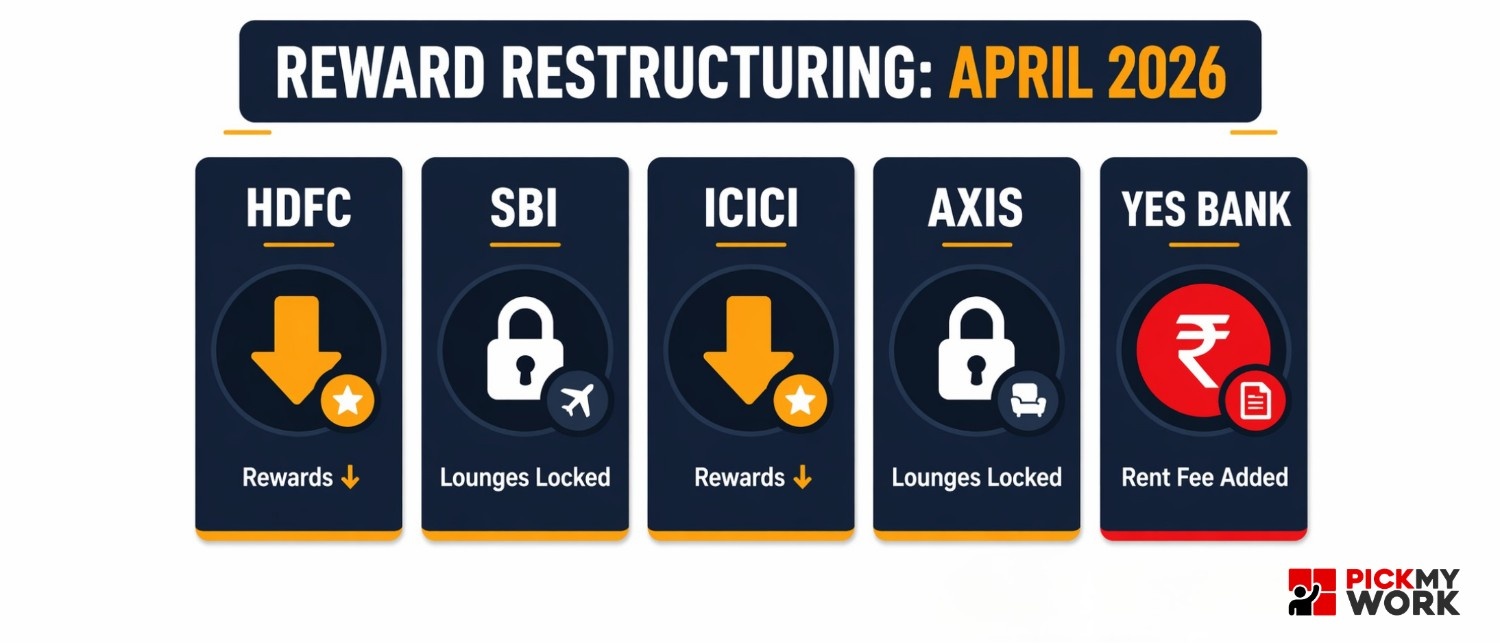
Beyond regulatory updates, individual banks have also restructured their credit card rewards significantly as part of this broader credit card rules change cycle. The industry trend is clear: unconditional, flat-rate rewards are shifting to spending-linked, conditional benefits.
Here is a bank-by-bank breakdown of the most important changes.
HDFC Bank Credit Card Rules Change
HDFC has revised several mid-tier and premium cards. For instance, the Regalia Gold and BizPower cards now earn 5 points per Rs 200 spent (changed from 4 points per Rs 150), which slightly reduces the effective reward rate. Furthermore, lounge access on the Regalia Gold now requires Rs 60,000 in spending during the previous quarter to unlock 3 domestic visits. Meanwhile, the HDFC Infinia Metal card now requires Rs 18 lakh in annual spending or Rs 50 crore Total Relationship Value to retain.
SBI Card Reward Changes
SBI’s Cashback Card now caps maximum monthly cashback at Rs 4,000, down from Rs 5,000 earlier. Additionally, reward points can only be redeemed in multiples of 4,000, which limits flexibility. On top of that, several premium and base-level SBI cards will no longer earn reward points on rent payments from April 2026.
ICICI Bank Credit Card Rules Change
ICICI is shifting to a spend-linked model for lounge access. As a result, cardholders now need Rs 35,000 in spending during the preceding quarter to unlock domestic lounge visits. The bank has also capped rewards on insurance and transportation categories and introduced a 2% fee on online gaming transactions.
Axis Bank and Yes Bank Updates
Axis Bank has capped reward points earned on insurance and utility bill payments. Similarly, Yes Bank has raised spending thresholds before transaction fees apply on utility and transportation payments. In addition, rent payments through third-party platforms now attract a 1% plus GST fee on Yes Bank cards.
| Bank | Key Change | Impact on Cardholders |
|---|---|---|
| HDFC Bank | Reward rate reduced; lounge access now spend-linked | Must spend Rs 60K/quarter for domestic lounges |
| SBI Card | Cashback cap lowered; rent rewards removed | Max cashback drops from Rs 5,000 to Rs 4,000/month |
| ICICI Bank | Spend-linked lounges; gaming fee introduced | Need Rs 35K/quarter for lounges; 2% fee on gaming |
| Axis Bank | Reward caps on insurance and utility payments | Lower reward accumulation on essential spends |
| Yes Bank | Higher thresholds; rent payment fee added | 1% + GST on rent via third-party platforms |
What Should You Do After This Credit Card Rules Change? (5 Action Steps)
- Review your annual credit card spending. If your total card spending crosses Rs 10 lakh in a year, your bank will report it. Therefore, check your last 12 months of statements and make sure your declared income supports your spending level.
- Set up biometric authentication on your banking apps. With mandatory 2FA now in effect, enable fingerprint or face recognition right away. As a result, your transactions will become smoother and more secure than relying solely on OTPs.
- Never miss a credit card payment going forward. Because of weekly CIBIL reporting, even short payment delays will show up faster on your credit profile. Set up auto-pay for at least the minimum due amount to protect your score.
- Separate personal and corporate card spending immediately. If you use a company card, strictly limit usage to official expenses only. Personal charges will now attract tax. Furthermore, keep receipts and get employer documentation for every business expense.
- Re-evaluate your credit card portfolio. With reward rates dropping and lounge access becoming conditional, check if your current cards still deliver value. It may be time to switch to a card that better matches your actual usage patterns. Explore our guides on the best UPI credit cards and best travel credit cards for updated picks.
Earn Extra Income with PickMyWork
Credit card rules change every year, but opportunities to earn stay strong. With PickMyWork, you can find flexible, part-time earning opportunities that work around your schedule.
Here is how it works:
- Download the PickMyWork app
- Sign up with your mobile number (no investment needed)
- Browse available tasks in credit cards, banking, and more
- Earn incentives for each successful activation
Perfect for: gig workers, students, part-time earners, and anyone looking for flexible income.
Related Reads on PickMyWork
- HDFC Regalia Gold Credit Card: Premium Rewards for the Smart Spender
- HDFC Pixel Play Credit Card: Lifetime Free, Custom Cashback
- Top 10 Banks in India by Market Cap
- Best UPI Credit Cards in India 2026
- Best Credit Cards for Insurance Payments India 2026
- Best Travel Credit Cards India 2026
- Online Work and Earn Money in India
Frequently Asked Questions
- Will I pay extra tax if my credit card spending crosses Rs 10 lakh?
No. Crossing the Rs 10 lakh threshold does not create a new tax liability. It simply means your bank will report the spending to the Income Tax Department. Problems arise only when there is a significant gap between your declared income and actual spending. - What happens if my biometric or OTP fails during a transaction?
The RBI’s 2FA framework is flexible. Banks can use multiple authentication methods including PINs, passwords, device tokens, and biometrics. If one method fails, your bank should offer an alternative. However, transactions that cannot complete two-factor authentication will be declined. - Does weekly CIBIL reporting affect my existing credit score immediately?
Not immediately. Your existing score reflects past behavior. However, from April 2026 onward, any new payments, whether timely or missed, will reflect in your credit report within 7 to 14 days instead of the earlier 15 to 30 days. - Can I still earn reward points on rent and utility payments?
It depends on your card and issuer. For example, SBI Card has removed rent rewards on several cards. Similarly, ICICI and Axis have capped utility and insurance rewards. HDFC has excluded rent, wallet loads, and education from reward-eligible categories on certain cards. Check your specific card’s updated terms on your bank’s website or app. - Will this credit card rules change slow down my everyday transactions?
Not significantly. The RBI has encouraged risk-based authentication. As a result, small, routine payments from a trusted device will process with minimal friction. Only high-value or unusual transactions will trigger the full multi-step verification. - Can I now pay income tax using my credit card?
Yes. Credit cards now qualify as an electronic mode for paying income tax dues. However, unpaid credit card balances attract high interest. Therefore, clear the amount within your billing cycle to avoid extra costs. - Is personal spending on a corporate credit card really taxable now?
Yes. From April 2026, personal expenses on employer-issued cards count as taxable perquisites. Only official expenses with proper employer documentation and certification remain exempt. - What are the best credit card options for me right now?
Check out all the credit cards here and choose the one that fits your spending style. You can fill your digital application right away.