
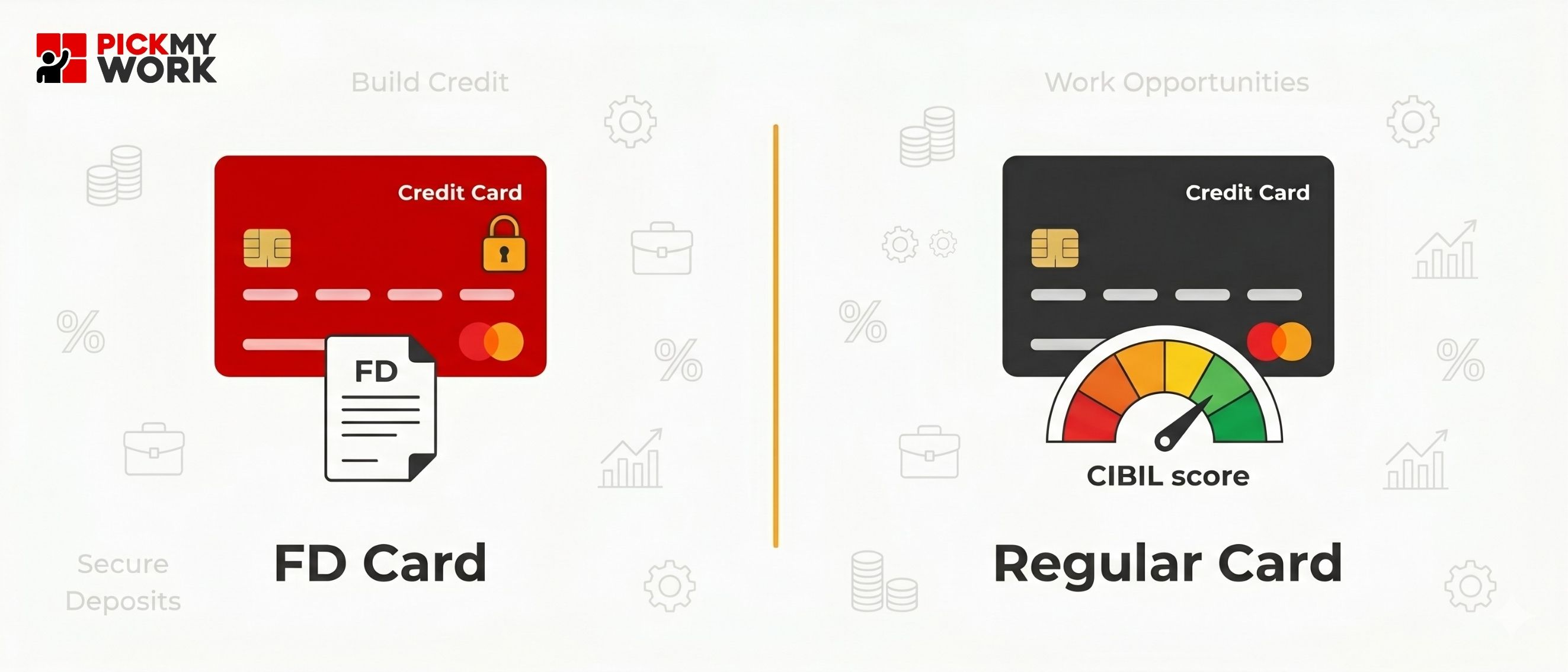
Getting a credit card in India often feels like a catch-22. Banks want a good CIBIL score, but you cannot build a CIBIL score without a credit card. For students, freelancers, homemakers, and anyone without a formal salary, this wall feels impossible to climb. That is exactly where a credit card against FD comes in.
A credit card against FD, also known as a secured credit card, lets you get a credit card by placing a Fixed Deposit as collateral. No income proof needed. No credit history required. Your FD secures the card, and you use it just like any other credit card. Meanwhile, your FD keeps earning interest in the background.
In this guide, we break down exactly how a credit card against FD works, how it differs from a regular credit card, who should get one, and which FD-backed cards are currently available on PickMyWork for you to sell or apply for right now.
What Is a Credit Card Against FD?
A credit card against FD is a secured credit card issued by a bank when you place a Fixed Deposit as collateral. The bank marks a lien on your FD, which means the deposit stays in your account and continues earning interest, but you cannot withdraw it while the card is active.
Your credit limit is directly tied to your FD amount. Most banks in India offer a credit limit of 80% to 100% of the FD value. For example, if you open an FD of Rs. 20,000, your credit limit will typically be between Rs. 16,000 and Rs. 20,000.
You spend on the card, pay your bills on time, and the bank reports your repayment behaviour to credit bureaus like CIBIL. Over time, responsible usage builds your credit score. Once your score improves, you can apply for a regular unsecured credit card and, if you choose, close the FD-backed card.
Credit Card Against FD vs Regular Credit Card: Key Differences
Here is a side-by-side comparison of the two card types across all the factors that matter most.
| Factor | Credit Card Against FD | Regular Credit Card |
|---|---|---|
| Collateral Required | Yes — Fixed Deposit | No collateral needed |
| Income Proof | Not required | Required (salary slip, ITR, or bank statement) |
| Credit Score Required | No minimum score needed | Typically 700+ CIBIL score required |
| Who Can Apply | Students, homemakers, freelancers, self-employed, those with low or no credit history | Salaried professionals with stable income and established credit history |
| Credit Limit | 80% to 100% of FD amount (set by deposit, not income) | Set by bank based on income and credit score — can be higher |
| Approval Rate | High if FD is opened (approval at the bank’s discretion) | Subject to eligibility check and bank discretion |
| FD Interest | FD keeps earning interest throughout | No FD involved |
| Annual Fee | Often zero or very low (many are lifetime free) | Varies — can be Rs. 500 to Rs. 5,000+ annually |
| Rewards and Benefits | Basic rewards, cashback, lounge access on some cards | More extensive rewards — travel, dining, milestone benefits, premium perks |
| Default Risk | Bank recovers dues from FD if you default | Credit score is impacted; recovery through legal process |
| Best For | Building credit history from scratch or rebuilding a damaged score | Maximising rewards, cashback, and premium benefits on everyday spending |
Who Should Get a Credit Card Against FD?
A credit card against FD is not just for people with poor credit. It is a practical first step for a wide range of situations.
First-Time Credit Users
Students and young professionals who have never taken a loan or used a credit card have no CIBIL history. Banks consider this risky. An FD-backed card removes this barrier entirely. You can start building your credit profile from day one without needing a salary slip.
Freelancers and Self-Employed Individuals
Banks typically ask for 6 months of salary slips or 2 years of ITR to approve a regular credit card for self-employed individuals. Freelancers and gig workers often cannot meet this requirement. A credit card against FD bypasses income proof altogether.
Homemakers
Homemakers manage household finances and often have savings, but no declared income. An FD-backed card gives them independent access to credit without depending on a spouse or family member’s income proof.
People Rebuilding Their Credit Score
If your CIBIL score has dropped due to a past default or missed payments, a secured credit card is one of the fastest ways to rebuild it. Consistent, on-time payments over 12 to 18 months can significantly improve your score.
Senior Citizens with FD Savings
Senior citizens often have substantial FD savings but are retired and have no income proof. An FD-backed credit card gives them easy access to credit for daily and emergency expenses without liquidating their savings.
Best Credit Cards Against FD Available on PickMyWork (2026)
The following FD-backed credit cards are currently active and available on the PickMyWork platform. AU NOMO has been checked against the bank’s official product page (October 2026); confirm the details of the other cards on each bank’s site before applying.
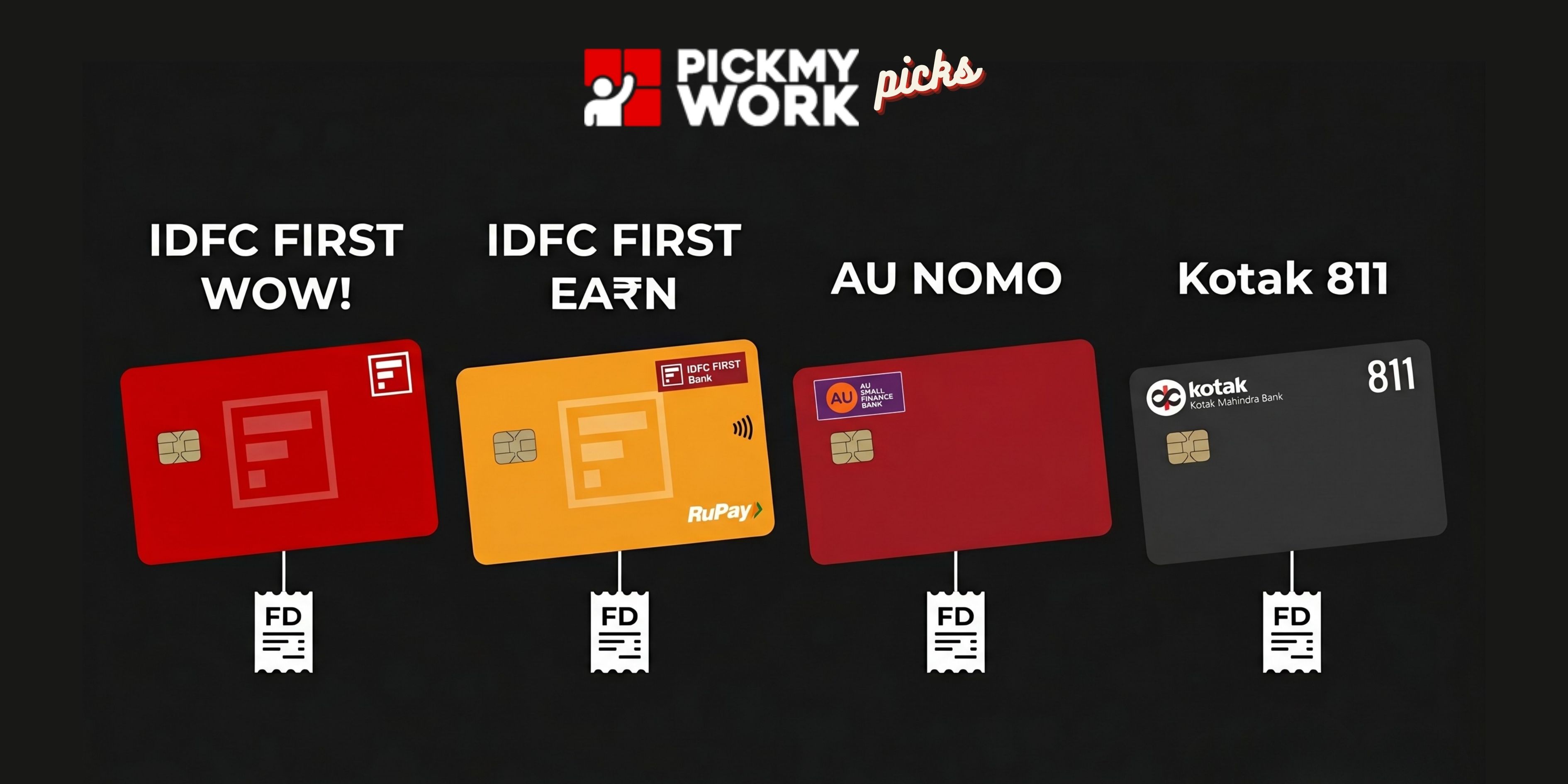
1. IDFC FIRST WOW! Credit Card
The IDFC FIRST WOW! Credit Card is one of the most popular FD-backed credit cards in India. It is lifetime free, requires no income proof or credit history, and offers a credit limit equal to 100% of the FD amount. The minimum FD required is Rs. 20,000 for new customers. Your FD earns interest at up to 6.3% per annum while serving as collateral. Additionally, the card charges zero forex markup on international transactions, making it useful for online international purchases as well. It is ideal for first-time credit users who want a no-cost entry into the credit system with decent benefits.
Minimum FD: Rs. 20,000 | Annual Fee: Nil (Lifetime Free) | Credit Limit: Up to 100% of FD | Key Benefit: Zero forex markup, 4X reward points
2. IDFC FIRST EA₹N Credit Card
The IDFC FIRST EA₹N is a virtual, UPI-enabled secured credit card backed by an FD of just Rs. 5,000. It is designed for digital-first users who want to start building their credit score using everyday UPI payments. The card is issued instantly on your smartphone and can be used across all UPI apps. It offers cashback on UPI spends via the IDFC FIRST Bank app and is an accessible, low-barrier entry point for new-to-credit individuals. Importantly, it is available on PickMyWork as part of the IDFC FIRST Bank credit card task category.
Minimum FD: Rs. 5,000 | Annual Fee: Nil | Card Type: Virtual, UPI-enabled | Key Benefit: Instant issuance, cashback on UPI spends
3. AU NOMO Credit Card (AU Bank)
The AU NOMO Credit Card is AU Small Finance Bank’s credit card backed by a fixed deposit. Your credit limit is linked to your FD amount, and the FD must be in your own name with AU Small Finance Bank. It is open to Indian residents aged 18-99, approval is at the bank’s discretion, and no income proof or documents are needed. The joining fee is Rs. 199 plus applicable taxes; the product page does not list a renewal fee, so check the MITC for the current renewal fee. Cardholders earn 2 reward points per Rs. 100 on retail spends and 1 point per Rs. 100 on utilities and insurance, plus 500 bonus points on your first transaction within 30 days of card setup. A quarterly milestone gives 500 points on Rs. 25,000 retail spend and 1,000 points on Rs. 50,000 (fuel and cash excluded). The card offers 2 complimentary domestic airport lounge visits each quarter on completing Rs. 50,000 spend in that quarter (effective 10 April 2026), and 2 complimentary railway lounge visits every quarter for you and add-on cardholders. A 1% fuel surcharge waiver (up to Rs. 100) applies on transactions between Rs. 400 and Rs. 5,000. The card charges a low forex markup of 0.99%, making it one of the better FD-backed options for occasional international spends.
Minimum FD: Check the bank’s current terms | Joining Fee: Rs. 199 + taxes (check MITC for renewal fee) | Credit Limit: Linked to your FD amount | Key Benefit: Quarterly lounge access, low forex markup
4. Kotak 811 #DreamDifferent Credit Card
The Kotak 811 #DreamDifferent is a secured, lifetime-free credit card backed by an FD of at least Rs. 10,000 with Kotak Mahindra Bank. It earns 4 reward points per Rs. 100 on online spends and 1 point per Rs. 100 on offline spends, making it one of the better rewards earners in the FD-backed segment. The card comes with a 1% fuel surcharge waiver and a railway surcharge waiver. A milestone benefit of a Rs. 1,000 voucher is unlocked on annual spends of Rs. 72,000. For those who spend primarily online, this card offers better reward accumulation than most other secured cards. Available on PickMyWork under the Kotak credit card task category.
Minimum FD: Rs. 10,000 | Annual Fee: Nil (Lifetime Free) | Credit Limit: Up to 90% of FD | Key Benefit: 4X rewards on online spends
FD Credit Card vs Regular Credit Card: Which Is Right for You?
The right choice depends entirely on where you are in your credit journey.
| Your Situation | Best Option | Recommended Card |
|---|---|---|
| No credit history, first credit card | Credit Card Against FD | IDFC FIRST WOW! |
| Freelancer or self-employed, no income proof | Credit Card Against FD | AU NOMO or Kotak 811 |
| Low CIBIL score, want to rebuild credit | Credit Card Against FD | IDFC FIRST WOW! or AU NOMO |
| Homemaker with savings, needs own credit card | Credit Card Against FD | IDFC FIRST EA₹N (low FD entry) |
| Salaried professional with 750+ CIBIL score | Regular Credit Card | HDFC, Axis, SBI unsecured cards |
| Want maximum rewards and travel benefits | Regular Credit Card | HDFC Regalia Gold, Axis Magnus |
Important Things to Know Before Getting a Credit Card Against FD
- Your FD is locked until you close the card. You cannot break or withdraw the FD while the credit card is active. If you need to close the FD, you must first settle all outstanding dues and close the credit card account.
- Keep your credit utilisation below 30%. Even with a secured card, using more than 30% of your credit limit regularly can negatively affect your CIBIL score. Aim to use the card for small, regular purchases and pay the full amount each month.
- Always pay the full outstanding amount, not just the minimum. Paying only the minimum due keeps you in debt and accrues heavy interest. Full monthly repayment is the fastest way to build your credit score.
- Your FD continues to earn interest throughout. This is a key advantage of FD-backed cards. Your savings are not wasted as a security deposit. They continue growing while you access credit.
- Defaulting allows the bank to recover dues from your FD. If you miss payments, the bank has the right to recover the outstanding amount by redeeming the lien-marked FD. This also severely impacts your CIBIL score.
Earn by Selling Credit Cards Against FD on PickMyWork
If you are a PickMyWork Partner, credit card tasks are among the most consistent and reliable earning opportunities on the platform. FD-backed credit cards have a high approval rate, which makes them significantly easier to sell compared to regular unsecured cards.
Here is why FD-backed credit card tasks work well for partners:
- Wider customer base. Students, homemakers, and freelancers who cannot get a regular card are valid leads. Your potential customer pool is much larger.
- Simpler pitch. No income documents needed. Just a PAN card, Aadhaar, and a small FD. Most customers find this process far less intimidating than a regular card application.
- High conversion rate. Approval is not subject to credit checks. As long as the customer opens the FD and completes KYC, the card is issued. Fewer rejections mean more completed tasks and more payouts for you.
- Multiple bank options available. IDFC FIRST Bank, AU Bank, and Kotak Mahindra Bank all have active credit card tasks on PickMyWork. You can pitch based on the customer’s preferred bank or FD amount.
Related Reads
- Best UPI Credit Cards in India 2026
- HDFC Pixel Play Credit Card Review — Lifetime Free, Custom Cashback
- HDFC Regalia Gold Credit Card Review — Premium Rewards Explained
- Best Travel Credit Cards in India 2026
- Best Credit Cards for Insurance Payments in India 2026
- How to Earn Money Online in India — A Practical Guide
- All Credit Cards Available on PickMyWork
Frequently Asked Questions About Credit Cards Against FD
- What is a credit card against FD?
A credit card against FD, also called a secured credit card, is issued by a bank when you place a Fixed Deposit as collateral. Your credit limit is linked to the FD amount, and no income proof or credit history is required. The FD continues earning interest while acting as security for the card. - What is the minimum FD amount needed to get a credit card?
The minimum FD amount varies by bank and card. IDFC FIRST EA₹N requires just Rs. 5,000. Kotak 811 #DreamDifferent requires a minimum of Rs. 10,000, while IDFC FIRST WOW! requires Rs. 20,000 for new customers. For AU NOMO, check the bank’s current terms. Always check the bank’s official website for the latest minimum amounts. - Does a credit card against FD help improve my CIBIL score?
Yes. Banks report your repayment activity to credit bureaus like CIBIL. Making on-time payments, keeping your credit utilisation below 30%, and maintaining the card for at least 12 to 18 months can meaningfully improve your credit score. - Can I withdraw my FD while my credit card is active?
No. The FD is marked as lien (security) by the bank as long as your credit card account is active. To access your FD, you must first pay all outstanding dues and close the credit card account. The bank will then release the lien on your FD. - Is a credit card against FD the same as a secured credit card?
Yes. A credit card against FD and a secured credit card refer to the same product. The term “secured” means the card is backed by collateral — in this case, your Fixed Deposit. It is distinct from an “unsecured” credit card, which has no collateral requirement. - What happens if I default on a credit card against FD?
If you miss payments and default, the bank has the right to recover the outstanding amount by redeeming your lien-marked FD. In addition, your CIBIL score is negatively impacted, which can affect your ability to apply for credit in the future. - Which is better — a credit card against FD or a regular credit card?
It depends on your situation. A credit card against FD is better if you have no credit history, no income proof, or a low credit score. A regular credit card is better if you have an established credit history and want higher limits, better rewards, and more premium benefits. - Are FD-backed credit cards available on PickMyWork?
Yes. PickMyWork currently has active credit card tasks for IDFC FIRST Bank (WOW! and EA₹N), AU Bank (NOMO), and Kotak Mahindra Bank (811 #DreamDifferent). Partners can earn commissions by completing credit card onboarding tasks for these banks on the PickMyWork app.