

ITR filing for freelancers and gig workers in India works differently from filing for salaried employees — and in FY 2025-26, the rules have changed significantly. You do not get a Form 16. Your clients may or may not deduct TDS. And April 2026 brought the most significant overhaul to India’s income tax law in six decades with the Income Tax Act, 2025 coming into force. Whether you are a PickMyWork Partner, a delivery executive, a content creator, a consultant, or a designer, understanding how to file ITR correctly for AY 2026-27 is not just about compliance — it protects your earnings and keeps your financial record clean for loans, visas, and future financial planning.
This complete guide covers exactly which ITR form freelancers and gig workers must use, how Section 44ADA presumptive taxation can reduce your tax burden, what deadlines now apply under the new rules, and what you must not miss when filing for AY 2026-27.
What Changed for Freelancers and Gig Workers Under New Tax Rules 2026
The Income Tax Act, 2025 came into effect on April 1, 2026, replacing the Income Tax Act, 1961. For most individual taxpayers, this does not change actual tax rates, deductions, or exemptions. What changes is the structure and numbering of the law — Section 44ADA, for instance, has been renumbered as Section 58, but its provisions remain identical according to the Income Tax Department.
Two changes from Budget 2025 directly affect ITR filing for freelancers and gig workers for FY 2025-26 (AY 2026-27):
- Zero tax up to Rs. 12 lakh under the new regime. As confirmed by the Ministry of Finance via PIB, individuals with taxable income up to Rs. 12 lakh pay zero income tax under the new tax regime through an enhanced rebate under Section 87A. This is a significant benefit for gig workers and freelancers with moderate annual earnings.
- Extended ITR deadline for freelancers and gig workers. The deadline for filing ITR-3 and ITR-4 for non-audit cases has been extended from July 31 to August 31, 2026 for FY 2025-26. Salaried individuals on ITR-1 and ITR-2 continue to have a July 31 deadline. If a tax audit is required, the deadline is October 31, 2026.
Is ITR Filing Mandatory for Gig Workers and Freelancers?
Yes. If your gross total income exceeds Rs. 3 lakh in FY 2025-26, ITR filing is mandatory under Section 139(1) of the Income Tax Act — even if TDS has already been deducted by your clients. Filing is also strongly advisable even below this threshold if you want to claim a TDS refund, apply for a loan or visa, or maintain a clean financial record. Many banks and financial institutions require the last two to three years of ITR as income proof for loan applications — a critical consideration for gig workers and freelancers who do not receive salary slips.
Not filing despite earning above the threshold attracts a late filing penalty of up to Rs. 5,000 under Section 234F, plus interest under Sections 234A, 234B, and 234C on any unpaid tax. The Income Tax Department actively tracks income through TDS returns, AIS data, and bank reports — so not filing is not a safe option.
Which ITR Form Should Freelancers and Gig Workers Use for AY 2026-27?
Freelancers and gig workers cannot use ITR-1, which is for salaried individuals only. All freelance and gig income is classified under Profits and Gains from Business or Profession (PGBP), which requires either ITR-3 or ITR-4 depending on your annual receipts and whether you opt for the presumptive taxation scheme.
| ITR Form | Who Should Use It | Condition |
|---|---|---|
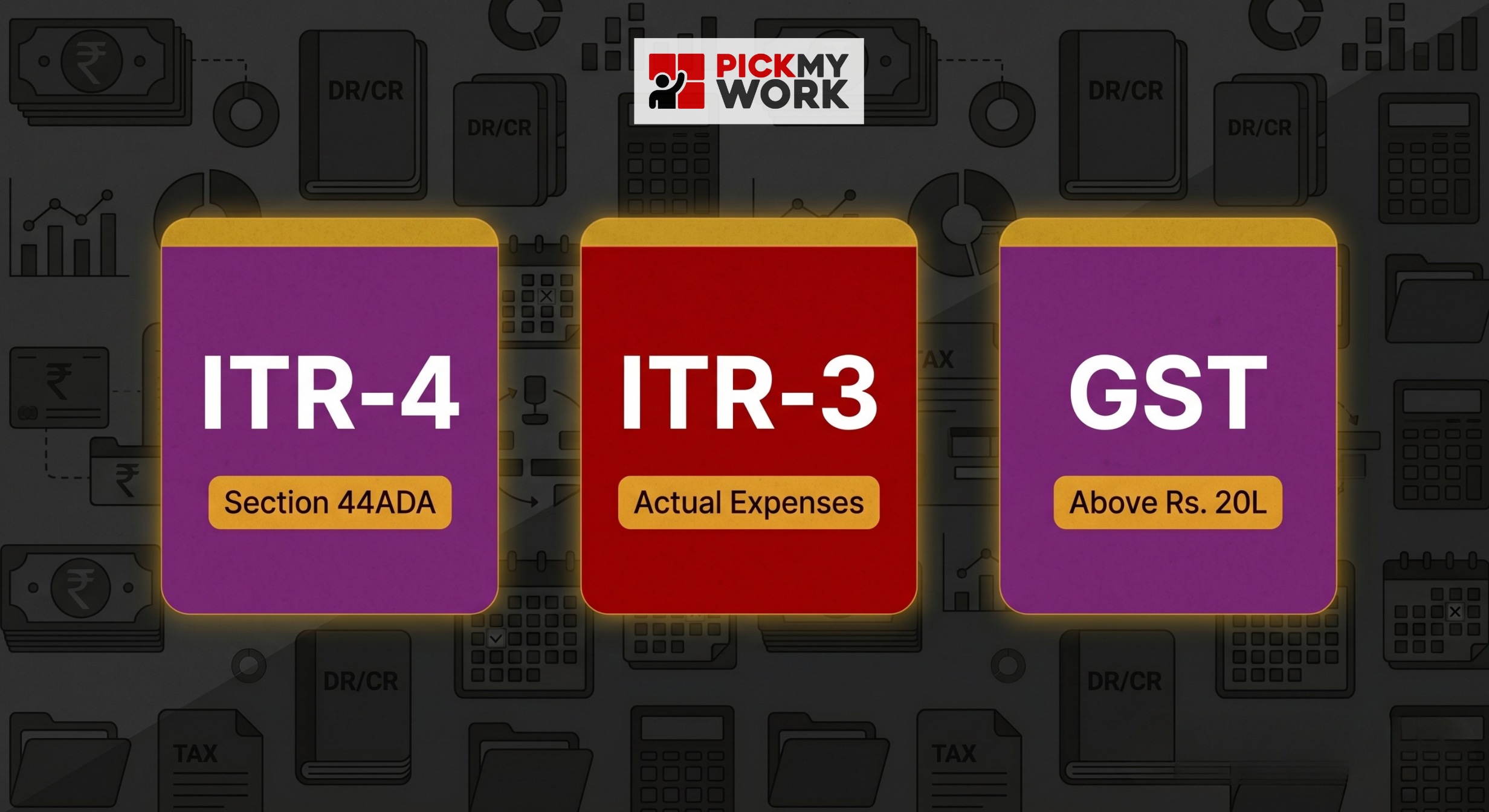
| ITR-4 (Sugam) | Freelancers and gig workers opting for presumptive taxation under Section 44ADA | Gross receipts up to Rs. 50 lakh (or Rs. 75 lakh if 95% of receipts are through digital or banking channels) |
| ITR-3 | Freelancers who want to claim actual expenses or whose receipts exceed Rs. 75 lakh | Requires maintaining books of accounts; tax audit may be required above Rs. 50 lakh receipts |
Important: If you are a salaried individual who also earns freelance income on the side, you must file ITR-3 — not ITR-1 — even if your freelance income is small. Filing the wrong form will result in your return being rejected by the Income Tax Department.
Section 44ADA Presumptive Taxation — How Freelancers Save Tax in 2026
Section 44ADA is the single biggest tax advantage available to freelancers and gig workers in India. Under this presumptive taxation scheme, the Income Tax Department assumes that 50% of your gross receipts is your taxable income — regardless of your actual expenses. You pay tax on that 50% and are not required to maintain detailed books of accounts or get your accounts audited, provided receipts stay within the threshold. This is confirmed by the Income Tax Department’s official FAQ on presumptive taxation at incometaxindia.gov.in.
For example: if a freelance graphic designer earns Rs. 30 lakh in FY 2025-26, the taxable income under Section 44ADA is Rs. 15 lakh. Tax is calculated on Rs. 15 lakh at the applicable new regime slab rates. The designer does not need to show actual expenses or maintain formal accounts. Personal deductions under Chapter VI-A — such as Section 80C investments and Section 80D health insurance — can still be claimed under the old tax regime on top of the 50% presumptive income.
Eligibility conditions under Section 44ADA as confirmed by the Income Tax Department:
- You must be a resident individual or Hindu Undivided Family (HUF).
- Your gross receipts must not exceed Rs. 50 lakh in the financial year. This limit increases to Rs. 75 lakh if cash receipts do not exceed 5% of total gross receipts.
- Your income must be from a specified profession — this includes legal, medical, engineering, architecture, accountancy, interior decoration, technical consultancy, and authorised representative services. Content creators, designers, and IT consultants generally qualify under technical consultancy.
New Tax Regime vs Old Tax Regime — Which Is Better for Freelancers in AY 2026-27?
The new tax regime is the default from FY 2025-26. Under it, taxable income up to Rs. 12 lakh is effectively tax-free through the Section 87A rebate — confirmed by the Ministry of Finance’s official Budget 2025 announcement. The new regime offers lower slab rates but does not allow most deductions including Section 80C, 80D, or HRA.
The old regime allows deductions such as 80C (up to Rs. 1.5 lakh), 80D (health insurance), and home loan interest — but has higher base tax rates. For a freelancer earning Rs. 15 lakh under Section 44ADA, the taxable income is Rs. 7.5 lakh. Under the new regime, this falls below Rs. 12 lakh and attracts zero tax. In this scenario, the new regime is clearly the better choice.
However, if your taxable income is higher and you have substantial investments and deductions, compare your liability under both regimes before filing. Freelancers with business or professional income who want to switch out of the new regime must file Form 10-IEA before the deadline. Unlike salaried individuals, business income filers can switch to the old regime only once — and re-entry into the new regime after that is allowed only once in a lifetime, as clarified by the Income Tax Department.
How to File ITR for Freelancers and Gig Workers — Step by Step (AY 2026-27)
- Gather all income records. Collect all client invoices, platform payment statements (Upwork, Fiverr, PickMyWork, Swiggy, Zomato), and bank credits from April 1, 2025 to March 31, 2026. If you received foreign payments, convert them to INR using the RBI reference rate on the date of receipt.
- Download and verify Form 26AS and AIS. Log in to the Income Tax e-filing portal at incometax.gov.in. Download your Annual Information Statement (AIS) and Form 26AS. Cross-check every TDS entry. Clients paying professional fees deduct TDS under Section 194J at 10%. Platform payments may fall under Section 194C at 1-2%. Any mismatch can trigger a notice from the Income Tax Department.
- Choose your ITR form. Select ITR-4 if your gross receipts are within the Section 44ADA threshold and you want the simpler presumptive route. Select ITR-3 if your receipts exceed the limit or you prefer to claim actual expenses.
- Select your tax regime. The new regime is the default. If you want the old regime and have business or professional income, you must file Form 10-IEA before the ITR deadline. Compare your tax liability under both before deciding.
- Enter income and compute tax. Under ITR-4, navigate to the Schedule PGBP section. Enter your total gross receipts. The portal automatically computes 50% as taxable income under Section 44ADA. Under ITR-3, enter actual income and all claimable expenses.
- Pay advance tax if applicable. If your total tax liability exceeds Rs. 10,000 in a year, advance tax is mandatory. Under Section 44ADA, the entire advance tax can be paid as a single installment on or before March 15 of the financial year — a significant simplification compared to the quarterly schedule for other taxpayers.
- File and e-verify your return. Submit the return on incometax.gov.in before August 31, 2026 for non-audit ITR-3 and ITR-4 filers. Verify immediately using Aadhaar OTP, net banking, or a digital signature. An unverified return is treated as not filed.
GST Registration — Do Freelancers and Gig Workers Need It?
GST and income tax are completely separate obligations. If your aggregate annual turnover exceeds Rs. 20 lakh (Rs. 10 lakh in North Eastern and hill states), GST registration is mandatory regardless of your income tax position. Most freelance services attract GST at 18%. Importantly, if you are GST-registered, your ITR gross receipts must match your GSTR-3B filings exactly — a mismatch between the two is one of the most common reasons the CBDT sends scrutiny notices to freelancers and gig workers.
ITR Filing Deadlines for Freelancers and Gig Workers — FY 2025-26 (AY 2026-27)
| Action | Deadline | Applicable To |
|---|---|---|
| Advance tax — full payment (Section 44ADA filers) | March 15, 2026 | Freelancers under Section 44ADA |
| ITR-3 and ITR-4 filing (non-audit cases) | August 31, 2026 | Freelancers and gig workers (non-audit) |
| ITR-3 and ITR-4 filing (audit cases) | October 31, 2026 | Freelancers with receipts requiring statutory audit |
| Belated or revised return | December 31, 2026 | Anyone who missed the original deadline |
PickMyWork Partners — Why ITR Filing Matters for Gig Workers
As a PickMyWork Partner, your task commissions are gig income taxable under Profits and Gains from Business or Profession. ITR filing for gig workers like you is not just a compliance requirement — your ITR is one of your most valuable financial documents. Banks require it for personal loans, home loans, and credit card applications. A consistent ITR filing history builds your financial credibility in exactly the same way a salary slip does for a salaried employee. Without it, accessing formal credit becomes significantly harder.
File every year, even in years where your income is below the taxable threshold. A nil return costs nothing to file but the financial record it creates over multiple years is invaluable for future loan applications, visa applications, and financial planning.
Related Reads
- New Income Tax Rules 2026 for Salaried Employees
- How to Earn Money Online in India — A Practical Guide
- Credit Card Rules That Changed in April 2026
- Best Credit Cards for Insurance Payments in India 2026
- Best UPI Credit Cards in India 2026
- All Credit Cards Available on PickMyWork
Frequently Asked Questions on ITR Filing for Freelancers and Gig Workers
- What is the process for ITR filing for freelancers and gig workers in India?
ITR filing for freelancers and gig workers in India involves choosing between ITR-3 and ITR-4 (not ITR-1, which is for salaried individuals), verifying Form 26AS and AIS on incometax.gov.in, declaring income under the PGBP head, opting for Section 44ADA presumptive taxation if eligible, and submitting the return before August 31, 2026 for non-audit cases under AY 2026-27. - Which ITR form should a freelancer file for AY 2026-27?
Most freelancers should file ITR-4 (Sugam) if they opt for presumptive taxation under Section 44ADA and their gross receipts are within Rs. 50 lakh (or Rs. 75 lakh if 95% of receipts are through banking channels). Those with higher receipts or who prefer to claim actual expenses must file ITR-3. - What is the ITR filing deadline for freelancers and gig workers in FY 2025-26?
The ITR filing deadline for freelancers and gig workers filing ITR-3 or ITR-4 for non-audit cases is August 31, 2026 for FY 2025-26 (AY 2026-27). This is an extension from the earlier July 31 deadline, confirmed by ClearTax and multiple sources citing the new Income Tax Act 2025. Audit cases have until October 31, 2026. - What is Section 44ADA and how does it help freelancers with ITR filing?
Section 44ADA is a presumptive taxation scheme under the Income Tax Act that allows eligible freelancers and professionals to declare 50% of their gross receipts as taxable income without maintaining detailed books of accounts. The remaining 50% is presumed to cover all business expenses. This reduces both tax liability and the compliance burden for ITR filing significantly. - Is income up to Rs. 12 lakh tax-free for freelancers in AY 2026-27?
Under the new tax regime, resident individuals with taxable income up to Rs. 12 lakh pay zero income tax through the enhanced rebate under Section 87A — as confirmed by the Ministry of Finance’s official Budget announcement. For a freelancer earning Rs. 24 lakh with Section 44ADA, the taxable income is Rs. 12 lakh, which means zero tax under the new regime. This benefit does not apply to special rate income such as capital gains. - Do PickMyWork Partners need to file ITR?
Yes. Commission income earned through PickMyWork tasks is gig income taxable under Profits and Gains from Business or Profession. If total annual earnings exceed Rs. 3 lakh, ITR filing is mandatory. Filing also builds your financial record, which is essential for loan applications, credit card approvals, and other financial services. - Do freelancers and gig workers need to register for GST?
GST registration is mandatory if your aggregate annual turnover exceeds Rs. 20 lakh (Rs. 10 lakh in North Eastern and hill states). Most freelance services are taxed at 18% GST. GST and income tax are separate obligations — ITR filing for freelancers and gig workers does not cover GST compliance. You may need to comply with both depending on your turnover. - Can freelancers use both Section 44ADA and the new tax regime together?
Yes. There is no restriction on combining Section 44ADA presumptive taxation with the new tax regime. This combination is often the most tax-efficient option for ITR filing for freelancers and gig workers with moderate incomes — it reduces taxable income to 50% of gross receipts and then applies the lower new regime slab rates, potentially resulting in zero tax for those earning up to Rs. 24 lakh annually.