
The freelancing vs full time job debate in India in 2026 is no longer just about money — it is about how you want to structure your working life, how much risk you can absorb, and how India’s tax system treats you depending on what you choose. A freelancer and a salaried employee both earning Rs. 15 lakh per year can end up with meaningfully different take-home income, completely different tax obligations, and fundamentally different day-to-day lives. Neither path is objectively better. But the right answer for you depends on factors most comparison articles do not cover honestly. This guide breaks it all down — salary, taxes under the new regime, benefits, job security, and freedom — so you can make the call with clear numbers in front of you.
Freelancing vs Full Time Job — Complete Comparison at a Glance
Here is every major dimension compared side by side before the detailed breakdown.
| Factor | Freelancing | Full Time Job |
|---|---|---|
| Income | Variable — no floor, no ceiling | Fixed monthly salary, defined increments |
| Tax Head | PGBP — Profits and Gains from Business or Profession (verify applicability with a CA for your specific income type) | Income from Salaries |
| Tax Advantage | Section 44ADA — only 50% of income taxable (applicable to specified professionals only — verify eligibility with a CA) | Standard deduction of Rs. 75,000 under new regime |
| ITR Form | ITR-3 or ITR-4 (depends on income type and turnover — confirm with a CA) | ITR-1 or ITR-2 |
| TDS | 10% under Section 194J for professional services (consultants, writers, designers); 2% for technical services — applies above Rs. 50,000 per client per year | Employer deducts automatically — zero effort required |
| Health Insurance | Self-funded — individual policy Rs. 10,000-25,000/year | Group policy — employer-paid, family often covered |
| EPF / Retirement | No employer contribution — must self-invest via PPF or NPS | Employer contributes 12% of basic salary to EPF |
| Paid Leave | None — every day off is lost income | 15 to 30 paid days per year |
| Working Hours | Fully flexible — work when and how you choose | Fixed — typically 9 to 6, Monday to Friday or Saturday |
| Job Security | Client-dependent — income can drop without notice | Notice period protection, severance in some cases |
| Income Ceiling | No ceiling — scales with skill and client base | Defined by employer’s band and increment cycle |
| Loan Eligibility | Harder — requires 2-3 years of ITR as proof of income | Easier — salary slip is accepted by all banks |
Salary and Earning Potential — Who Earns More in India in 2026?
The honest answer is: it depends on your skill and discipline. Here is how earnings actually compare across experience levels.
- Beginner freelancer (0-1 year): Rs. 10,000 to Rs. 25,000 per month — often less than an entry-level salaried role in the same field. The first year of freelancing is typically the hardest financially.
- Experienced freelancer (2-4 years): Rs. 40,000 to Rs. 80,000 per month — typically higher than a mid-level salaried equivalent, with no commute costs and more control over workload.
- Specialist freelancer (5+ years): Rs. 1 lakh to Rs. 3 lakh per month or more. At this level, freelancing income regularly outpaces salaried equivalents — with the ceiling determined entirely by skill and client access, not an employer’s appraisal cycle.
- The hidden cost of a salaried CTC: Your CTC includes benefits that freelancers must self-fund. A Rs. 12 lakh CTC includes approximately Rs. 86,400 in employer EPF contribution, Rs. 25,000 to Rs. 60,000 in group health insurance, and 15 to 30 paid leave days — collectively worth Rs. 1.5 lakh to Rs. 2 lakh per year that does not appear in the salary figure but represents real financial value.
- The freelancer’s real take-home advantage: A freelancer earning Rs. 15 lakh gross has no employer EPF deduction from their income, can deduct legitimate business expenses before arriving at taxable income, and benefits from Section 44ADA presumptive taxation — all of which can meaningfully increase take-home versus a salaried employee at the same gross income level.
Tax — How India Taxes Freelancers vs Salaried Employees Differently in 2026
This is the dimension most comparison articles get wrong or oversimplify. The tax treatment of freelancers in India in 2026 is fundamentally different from salaried employees — and under the right structure, freelancers pay significantly less tax on the same gross income.
- Salaried employees — Income from Salaries head: Taxed on gross salary after a standard deduction of Rs. 75,000 under the new regime. Employer deducts TDS monthly through Form 16. No business expenses can be claimed. Under the new regime on a Rs. 15 lakh salary, taxable income is Rs. 14.25 lakh and tax liability is approximately Rs. 1.17 lakh.
- Freelancers — PGBP head with Section 44ADA: Under Section 44ADA presumptive taxation, only 50% of gross receipts is treated as taxable income. A freelancer earning Rs. 15 lakh has a taxable income of Rs. 7.5 lakh — well below the Rs. 12 lakh zero-tax threshold under the new regime’s Section 87A rebate. Effective tax: zero. The same Rs. 15 lakh income that costs a salaried employee Rs. 1.17 lakh in tax costs an eligible freelancer nothing under this structure.
- Section 44ADA eligibility limit: Available for professionals with gross receipts up to Rs. 50 lakh per year (Rs. 75 lakh if 95% of receipts are through banking channels). Income above this requires actual books of accounts and may require a statutory audit.
- Advance tax obligation for freelancers: If total tax liability exceeds Rs. 10,000 in a year, advance tax is mandatory. Under Section 44ADA, freelancers can pay the full advance tax as a single installment by March 15 — simpler than the quarterly schedule that applies to other business income.
Here is how the tax liability compares on the same Rs. 15 lakh gross income under the new regime in FY 2025-26:
| Factor | Salaried Employee | Freelancer (Section 44ADA) |
|---|---|---|
| Gross Income | Rs. 15,00,000 | Rs. 15,00,000 |
| Deduction / Presumptive Benefit | Rs. 75,000 standard deduction | Rs. 7,50,000 (50% presumptive under 44ADA) |
| Taxable Income | Rs. 14,25,000 | Rs. 7,50,000 |
| Tax Liability (New Regime) | Approx. Rs. 1,17,000 | Approx. Rs. 30,000 |
| Tax Saving vs Salaried | Baseline | Rs. 87,000 less tax per year |
Important caveat: The Section 44ADA benefit applies only if you are a specified professional — including consultants, designers, writers, IT professionals, and others under technical consultancy. It does not apply to trading income or manufacturing income. Always verify eligibility with a CA before structuring your income this way.
Freedom and Flexibility — The Real Trade-off
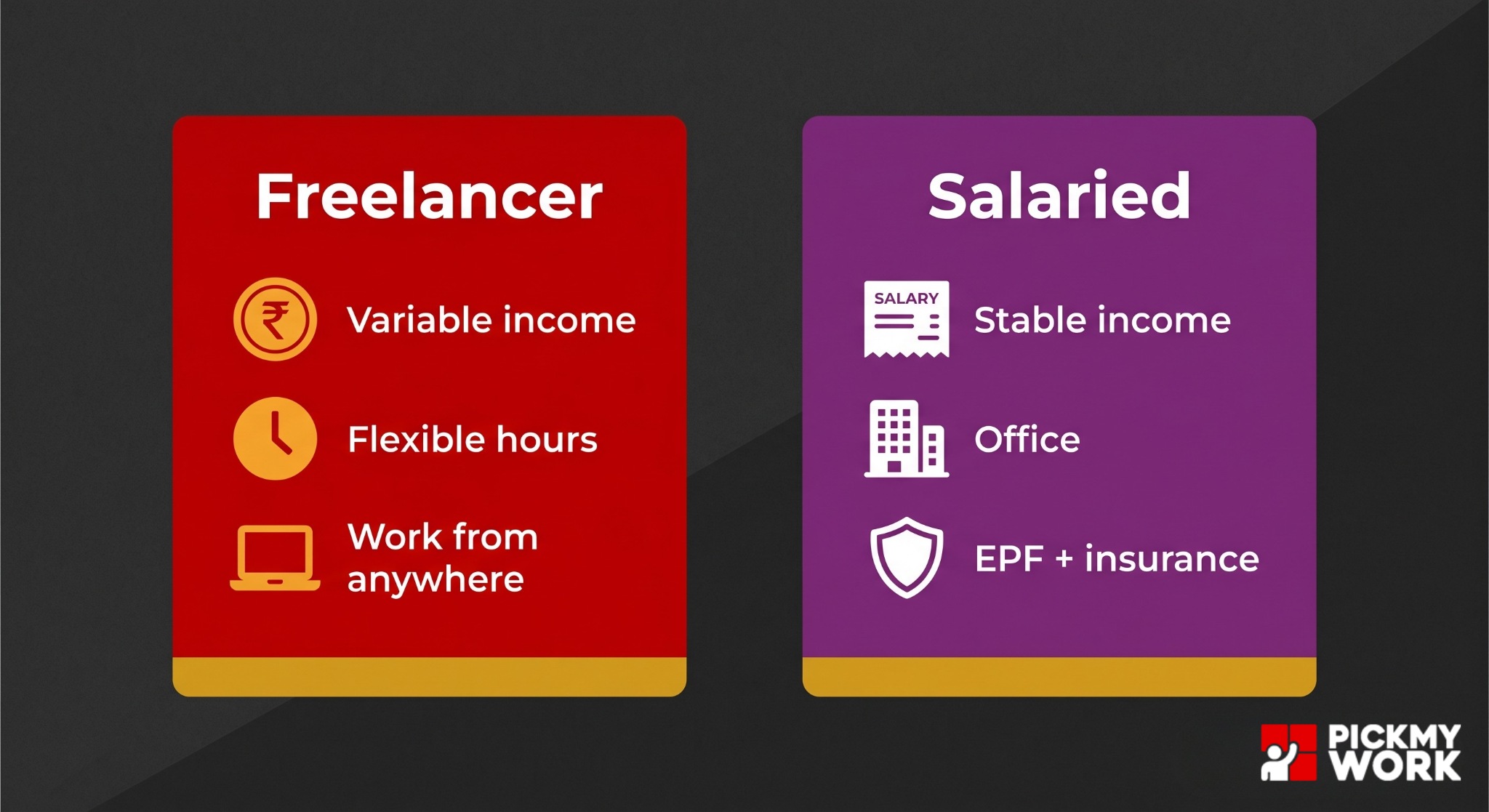
Freedom is the most cited reason people choose freelancing — and the most misunderstood one. Here is what it actually looks like in practice.
- Working hours: Freelancers set their own schedule. A salaried employee works the hours their employer defines. However, client deadlines, time zone differences, and the pressure of variable income mean many freelancers work longer hours than they did in a full-time role — at least in the early years.
- Location: Freelancers can work from home, a cafe, or another city entirely. Salaried employees are increasingly hybrid in 2026, but most Indian employers still require physical presence for 3 to 5 days per week. For someone in a Tier 2 city, freelancing can eliminate a commute worth 2 to 3 hours per day.
- Project choice: A freelancer picks what they work on. A salaried employee works on what they are assigned. This sounds obvious until you realise that choosing your own projects is also the responsibility of finding them — which is a skill in itself.
- Income stability: A salaried employee receives the same amount on the same date every month regardless of output. A freelancer’s income fluctuates with client pipelines, seasonal demand, and payment timelines — which can stretch 30 to 90 days after delivery. Financial planning is significantly harder without a predictable income floor.
- The psychological cost most articles skip: Freelancing removes structure, team belonging, and the clarity of a defined role. Many people underestimate how much they relied on these things until they no longer have them. The transition from salaried to freelance is as much a psychological shift as a financial one.
Job Security and Benefits — What You Give Up on Each Side
Benefits are where the full-time job wins most clearly — and where the comparison most often gets undersold.
- EPF and gratuity: Employers contribute 12% of basic salary to EPF — on a Rs. 12 lakh CTC with Rs. 6 lakh basic, that is Rs. 72,000 per year in retirement savings the employee contributes nothing toward. Gratuity adds further long-term value after 5 years of service. A freelancer building equivalent retirement savings must do so entirely with post-tax income through PPF or NPS.
- Group health insurance: Most Indian employers provide group health insurance covering Rs. 3 lakh to Rs. 5 lakh per year for the employee and often family members — worth Rs. 20,000 to Rs. 60,000 in annual premium that the employee pays nothing for. A freelancer purchasing equivalent individual coverage typically pays Rs. 10,000 to Rs. 25,000 per year for lower coverage with no pre-existing condition benefits in the first few years.
- Paid leave: 15 to 30 paid leave days per year means a salaried employee on Rs. 10 lakh annual salary receives effectively Rs. 41,000 to Rs. 82,000 in paid time off. A freelancer taking the same number of days off earns nothing during that period. This is rarely factored into freelancer income comparisons.
- Loan and credit access: Banks in India process home loans, car loans, and personal loans fastest for salaried applicants with a salary slip. Freelancers typically need 2 to 3 consecutive years of ITR to demonstrate income stability — and even then, lenders may apply a higher interest rate or require a larger down payment.
- Government insurance for gig workers — in pipeline: The Indian government is actively working on a social security framework for gig and platform workers under the new Labour Codes. This includes provisions for accident insurance, health coverage, and life insurance — currently being notified by the Ministry of Labour. Once fully operational, this will partially bridge the benefits gap between freelancers, gig workers, and salaried employees. For now, it remains a work in progress — but it is a meaningful signal that the government recognises gig work as a formal employment category.
Who Should Choose Freelancing vs Full Time in India in 2026?
There is no universal right answer. Here is a direct match based on where you are.
| Your Situation | Best Path | Why |
|---|---|---|
| Fresh graduate, no established network | Full time first | Skills, network, and financial cushion — all built faster in a structured role |
| 3-5 years experience, in-demand skill, self-disciplined | Freelancing | Income ceiling removed, tax advantage kicks in, EPF loss is manageable with self-investment |
| Family dependent on income, home loan active | Full time + gig side income | Jobs are not as secure as they once were — a side income on PickMyWork builds a financial buffer without leaving the stability of employment |
| Want to test freelancing without leaving job | Gig work as a side income | Build income proof, clients, and confidence before making the full switch |
| Experienced professional with established client network | Freelancing | Tax advantage maximised, income already proven, risk manageable |
| Student or homemaker, no full-time option available | Gig work to start | Fastest path to earning with zero investment, no experience required |
The Middle Path — Earn Extra While Keeping Your Job
The smartest move for most salaried Indians in 2026 is not an either-or choice. It is starting a side income stream while retaining the stability of a full-time job — building income proof, savings, and confidence before making any permanent switch. PickMyWork offers exactly this middle path. As a PickMyWork Partner, you complete app-based gig tasks — financial product onboarding, merchant sign-ups, and more — entirely on your phone, in your free time, at your own pace. There is no conflict with your employer, no business registration required, and no investment needed. Partners earn weekly commissions that go directly to their bank account. For anyone considering freelancing but not ready to make the jump, this is where you start — earning, building, and learning what it means to manage your own income before committing to it full-time.
Related Reads
- ITR Filing for Freelancers and Gig Workers in India 2026
- 5 Best Online Work Options for Students This Summer 2026
- How to Earn Money Online in India — A Practical Guide
- New Income Tax Rules 2026 for Salaried Employees
- Best Credit Cards for Rs. 50,000 Salary in India 2026
- All Credit Cards Available on PickMyWork
Frequently Asked Questions — Freelancing vs Full Time Job India 2026
- Is freelancing better than a full time job in India in 2026?
Neither is universally better. Freelancing offers higher income potential, tax advantages under Section 44ADA, and complete flexibility — but comes with income variability, no employer benefits, and harder loan eligibility. A full-time job offers stability, EPF, group health insurance, and easier credit access but limits earning potential. The right choice depends on your experience level, financial obligations, and risk tolerance. - Do freelancers pay less tax than salaried employees in India?
In many cases, yes. Under Section 44ADA presumptive taxation, eligible freelancers declare only 50% of gross receipts as taxable income. A freelancer earning Rs. 15 lakh pays tax on Rs. 7.5 lakh — compared to a salaried employee on the same income who pays tax on Rs. 14.25 lakh after the standard deduction. Under the new regime for FY 2025-26, this difference can translate to Rs. 87,000 less in tax for the freelancer on the same gross income. - What are the main financial disadvantages of freelancing in India?
The main financial disadvantages are the absence of employer EPF contribution (worth 12% of basic salary per year), no group health insurance, no paid leave, variable income with no guaranteed floor, and harder access to home loans and personal loans without 2-3 years of ITR. These hidden costs can amount to Rs. 1.5 lakh to Rs. 2 lakh per year in real financial value that salaried employees receive automatically. - Can I do freelancing while working a full-time job in India?
Yes, provided your employment contract does not have a non-compete or exclusivity clause that prohibits outside income. In practice, most Indian employment contracts restrict working for direct competitors but not general freelancing. Freelance income earned alongside salary must be reported separately under PGBP in your ITR — you cannot use ITR-1 if you have freelance income, even if it is small. - Which ITR form should a freelancer use in India in 2026?
Freelancers use ITR-4 if they opt for Section 44ADA presumptive taxation and their gross receipts are within Rs. 50 lakh (or Rs. 75 lakh if 95% of receipts are through banking channels). Those with higher receipts or who prefer to claim actual business expenses file ITR-3. Salaried employees file ITR-1 unless they have additional income sources, in which case ITR-2 applies. - How do I start earning independently without leaving my full-time job?
Gig work platforms like PickMyWork let you earn commissions on your phone, in your spare time, without leaving your job or making any investment. You complete structured tasks — helping people apply for financial products — and earn weekly payouts directly to your bank account. It is one of the fastest ways to build an independent income stream and experience managing variable earnings before considering a full transition to freelancing.