


Store Audit · Case Study
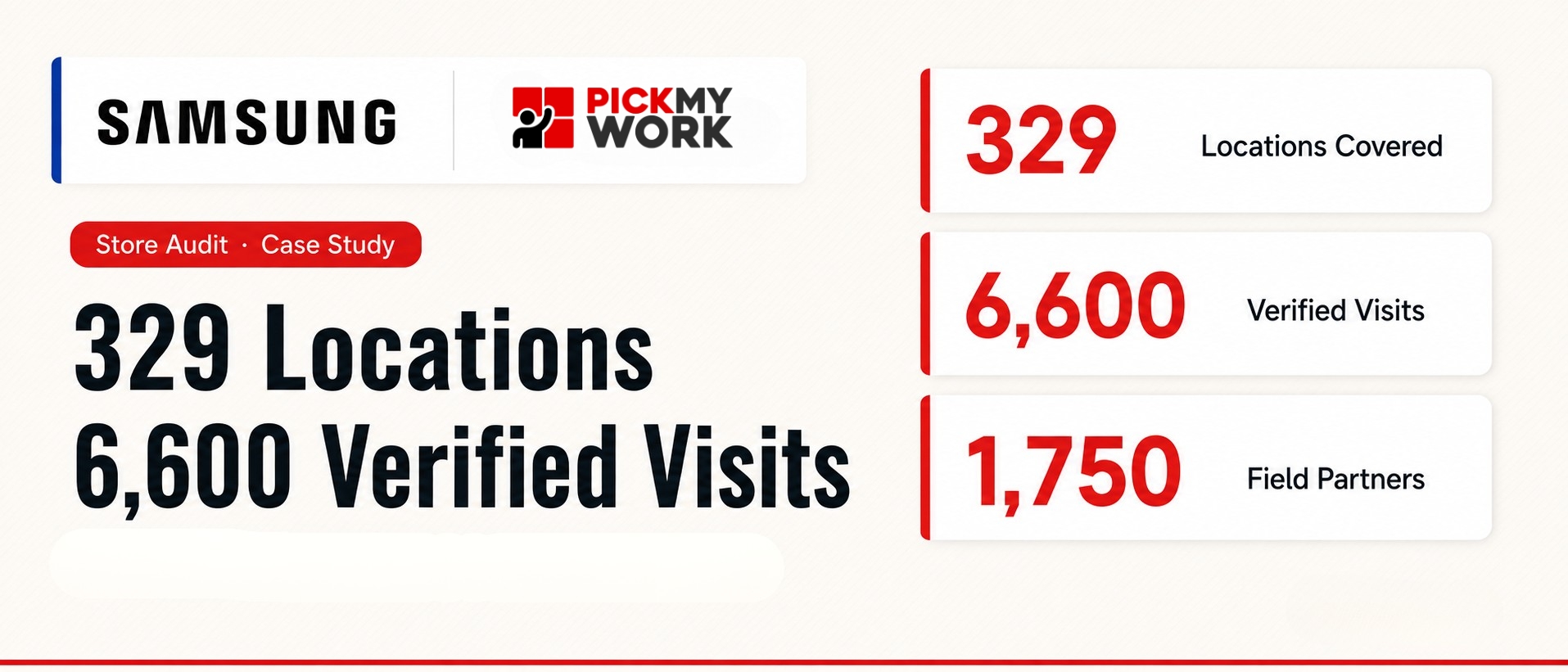
Retail audit services India operate at their most effective when scale, speed, and repeat verification work together as a single programme. Between June and July 2025, PickMyWork deployed 1,750 trained field partners across Samsung’s retail network — covering 329 store locations and completing 6,600 verified visits within a 54-day window. This is not a spot-check. At roughly 20 verified visits per location on average, this retail audit services India programme was built to track consistency over time, not just capture a single moment. This case study covers how that programme was structured, what it was designed to uncover, and what the scale of the data means for consumer electronics brands running distributed retail networks across India.
Samsung operates through a vast network of retail partners, exclusive brand stores, and multi-brand outlets across India. The in-store experience a customer receives at a Samsung outlet in one city can differ significantly from what a customer encounters in another. Staff may recommend a competing brand, demo units may be unavailable or poorly presented, and product guidance may be inaccurate. Samsung has no direct line of sight into any of this without independent, on-ground verification.
The Challenge — What Consumer Electronics Brands Cannot Control From Head Office
Consumer electronics is one of the most competitive retail categories in India. A customer walking into a Samsung outlet has already done significant research online. The in-store interaction is the moment that either confirms their purchase intent or redirects it to a competitor. Whether a staff member demonstrates a product confidently, whether the display unit is functional, and whether the overall experience matches what Samsung’s brand promises — none of this is auditable through internal reporting alone.
The specific risks Samsung needed to address are common across the consumer electronics category. Do staff lead with Samsung products or default to alternatives that carry higher margins for the store? Are demo units maintained and presented correctly? Is the brand’s visual merchandising being executed as specified? And critically — do these standards hold consistently across visits, or do stores perform well on a single check and revert afterward? That last question is why repeat visits matter. A one-time mystery audit tells you what a store looked like on one day. Multiple verified visits across the same location tell you whether standards are actually embedded.
PickMyWork’s retail audit and market research offering is built to handle exactly this kind of multi-visit, high-frequency programme across a large, geographically distributed retail network.
The Approach — Retail Audit Services India Deployed Across Samsung’s Network
PickMyWork mobilised 1,750 field partners across Samsung’s retail network starting 4 June 2025. Partners visited assigned Samsung locations as independent mystery evaluators, each assessing the store against a structured audit framework. Every visit was GPS-verified and timestamped at the point of entry through the PickMyWork Field App. Photo evidence was captured in real time. No manual data entry was involved at any stage.
The 54-day programme window and 6,600 total verified visits across 329 locations means each store received multiple independent evaluations over the course of the engagement. This design makes it possible to distinguish between a location that performs well because it knew it was being checked and a location where standards are genuinely consistent regardless of whether an audit is expected.
| Audit Dimension | What Was Evaluated |
|---|---|
| Staff Product Guidance | Whether store staff led with Samsung products, demonstrated accurate product knowledge, and gave recommendations consistent with the brand’s positioning |
| Demo Unit Availability and Condition | Whether Samsung demo units were present, switched on, functional, and presented in a condition that supports the in-store customer journey |
| Visual Merchandising Compliance | Adherence to Samsung’s display standards, branding guidelines, point-of-sale material placement, and in-store key visual requirements |
| Customer Interaction Quality | The overall in-store experience as encountered by a mystery visitor — staff responsiveness, engagement quality, and alignment with Samsung’s customer experience standards |
| Consistency Across Visits | Whether standards held across multiple independent visits to the same location — the measure that distinguishes genuine compliance from single-instance performance |
The Numbers — Samsung Store Audit at a Glance
The scale of the Samsung programme sets it apart from a standard mystery audit deployment. 6,600 verified visits across 329 locations in 54 days represents a level of field intelligence density that produces genuinely reliable, statistically meaningful data about how Samsung’s retail network performs.
| Programme Detail | Verified Figure |
|---|---|
| Brand | Samsung |
| Audit Type | Store Mystery Audits |
| Engagement Period | 4 June 2025 to 27 July 2025 (54 days) |
| Locations Covered | 329 |
| Verified Visits | 6,600 |
| Field Partners Deployed | 1,750 |
| Average Visits Per Location | Approximately 20 — enabling consistency tracking, not just snapshot auditing |
| Data Collection | GPS-verified, timestamped, photo evidence via PickMyWork Field App |
What the Data Tells You — Key Insights from the Samsung Programme
A programme of this scale generates four categories of insight that no other verification method can produce. Each has direct implications for how Samsung — and any consumer electronics brand managing a wide retail network — allocates its training, compliance, and retail investment resources.
What Good Repeat-Visit Audit Data Looks Like
Most mystery audit programmes are designed as single-visit exercises. One evaluator, one visit, one data point per location. That approach is useful for a compliance snapshot but insufficient for understanding whether standards are embedded at the store level. The Samsung programme was designed differently — and the principles that make repeat-visit data credible are worth understanding for any brand considering field intelligence at this scale.
Different evaluators on each visit to the same location. Sending the same field partner to a Samsung store repeatedly introduces familiarity bias and risks the store recognising the evaluator. PickMyWork’s 1,750-partner deployment ensures each visit to each location is conducted by a different, unrecognised evaluator.
GPS verification on every single visit without exception. Each of the 6,600 Samsung visits in this programme was geo-tagged at entry. There is no ambiguity about whether a field partner was physically present at the correct location.
Identical audit framework applied across all locations and all visits. Consistency in what is being measured is what makes Samsung’s 329 locations genuinely comparable to each other and what makes visit-over-visit trends meaningful rather than noise.
Scale and Speed — Why Both Matter for Retail Intelligence
Volume large enough to be statistically meaningful. 6,600 visits is not a sample — it is a comprehensive dataset. Patterns that emerge from this volume reflect genuine network behaviour, not statistical coincidence driven by a small number of observations.
Compressed timeframe that reflects real operating conditions. Completing 6,600 visits in 54 days means the data reflects Samsung’s retail network as it actually operates under normal trading conditions — not after a cleanup prompted by advance notice of an audit.
Automated reporting that delivers findings while they are still actionable. PickMyWork’s Field App pipeline eliminates manual data entry and report compilation delays. Samsung receives findings fast enough to respond to gaps before the next wave of customer interactions compounds them.
Retail Audit Services India — Industries Where Repeat Visits Change the Decision
The Samsung programme demonstrates why high-frequency, multi-visit mystery audit services are more valuable than single-visit snapshots for any brand where in-store experience is a competitive differentiator. The industries where this matters most are those where staff behaviour, product presentation, and brand consistency directly influence purchase decisions at the point of sale.
| Industry | What Repeat Visits Reveal |
|---|---|
| Consumer Electronics | Whether staff consistently recommend the brand’s own products, maintain demo units, and deliver a purchase experience that matches brand standards across visits and geographies |
| Automotive | Whether dealer staff product knowledge and customer interaction standards hold across visits — not just during scheduled reviews — and where retraining investment will have the highest impact |
| Telecom | Whether retail staff follow approved sales and billing SOPs consistently, or whether process deviations are isolated incidents or systemic patterns across the network |
| Banking and Fintech | Whether branch and agent onboarding standards are genuinely embedded or surface-level compliant — a distinction that only emerges across multiple unannounced evaluations |
| FMCG and CPG | Whether planogram compliance and share-of-shelf positions are maintained between scheduled merchandising visits, or whether stores revert to previous layouts within days |
| Apparel and Retail | Whether visual merchandising and brand experience standards hold across peak and off-peak trading periods — and whether staff behaviour varies by shift, day, or store format |
Why PickMyWork for Retail Audit Services India
The Samsung programme required 1,750 field partners mobilised across 329 locations within days of programme launch, sustaining 6,600 verified visits over 54 days without a drop in data quality. That kind of execution is only possible because of the structural advantages PickMyWork’s field network provides. These are the reasons brands across India — including Samsung — trust PickMyWork’s retail audit and market research services for field intelligence at scale.
Is Your Retail Network Performing the Way You Think It Is?
The Samsung programme produced 6,600 verified data points from 329 real store visits — each one a ground-truth reading of what a customer actually encounters at a Samsung outlet. If your brand operates through a distributed retail network and is relying on internal checks or scheduled visits to verify standards, the evidence from programmes like this suggests those checks are not sufficient. PickMyWork’s field intelligence programmes are designed to replace assumption with evidence — at a scale and frequency that in-house teams cannot replicate.
Frequently Asked Questions
- What did the Samsung mystery audit programme cover?
PickMyWork ran store mystery audits across 329 Samsung retail locations between 4 June 2025 and 27 July 2025. The programme completed 6,600 verified visits using 1,750 field partners. Each visit evaluated staff product guidance, demo unit condition, visual merchandising compliance, and overall customer interaction quality — with GPS verification and timestamped photo evidence on every visit. - Why does Samsung need mystery audit services across its retail network?
Samsung operates through a large network of retail partners and brand outlets across India. The in-store experience a customer receives — whether staff recommend Samsung products, whether demo units work, whether brand display standards are met — varies significantly across locations. Mystery audits provide independent, on-ground evidence of what is actually happening, replacing internal reporting that reflects what stores want head office to see. - What is the difference between a single-visit and a repeat-visit mystery audit?
A single-visit audit captures what a store looks like on one day. A repeat-visit programme — like Samsung’s, which averaged approximately 20 visits per location — measures whether standards are consistently maintained or whether stores perform well only when they anticipate scrutiny. Repeat visits are the only way to distinguish genuine compliance from single-instance performance. - How does PickMyWork handle mystery audit programmes at this scale?
PickMyWork’s gig field network spans 1.15 Mn+ partners across 500+ cities and 19,000+ pincodes. Deploying 1,750 partners across 329 Samsung locations and completing 6,600 verified visits in 54 days is within standard execution capacity. All visits run through the PickMyWork Field App — GPS-verified, timestamped, and photo-evidenced with no manual data entry involved. - Which consumer electronics brands use mystery audit services in India?
Samsung is among the consumer electronics brands that have run field intelligence programmes through PickMyWork. Other sectors represented in PickMyWork’s 50+ active brand partner portfolio include telecom (Airtel), automotive (CEAT, Mahindra, Hyundai, Maruti Suzuki), and retail (Lenskart, Haldiram’s). Full details of the retail audit and market research offering are at pickmywork.com/retail-audits-market-research. - How do I start a mystery audit programme with PickMyWork?
Contact PickMyWork through the contact page with your programme scope — brand, locations to cover, audit parameters, and timeline. PickMyWork responds within one business day. Programmes at the scale of the Samsung engagement can be scoped, designed, and launched within days of sign-off.
Also Searched For
Samsung store audit India · Samsung mystery audit case study · Samsung retail compliance India · retail audit services India · mystery shopping company India · field audit company India · retail audit company India · consumer electronics store audit India · retail intelligence India · repeat visit mystery audit India · store compliance audit India · brand retail audit India · field intelligence company India · mystery shopping India case study · PickMyWork Samsung · PickMyWork retail audits