
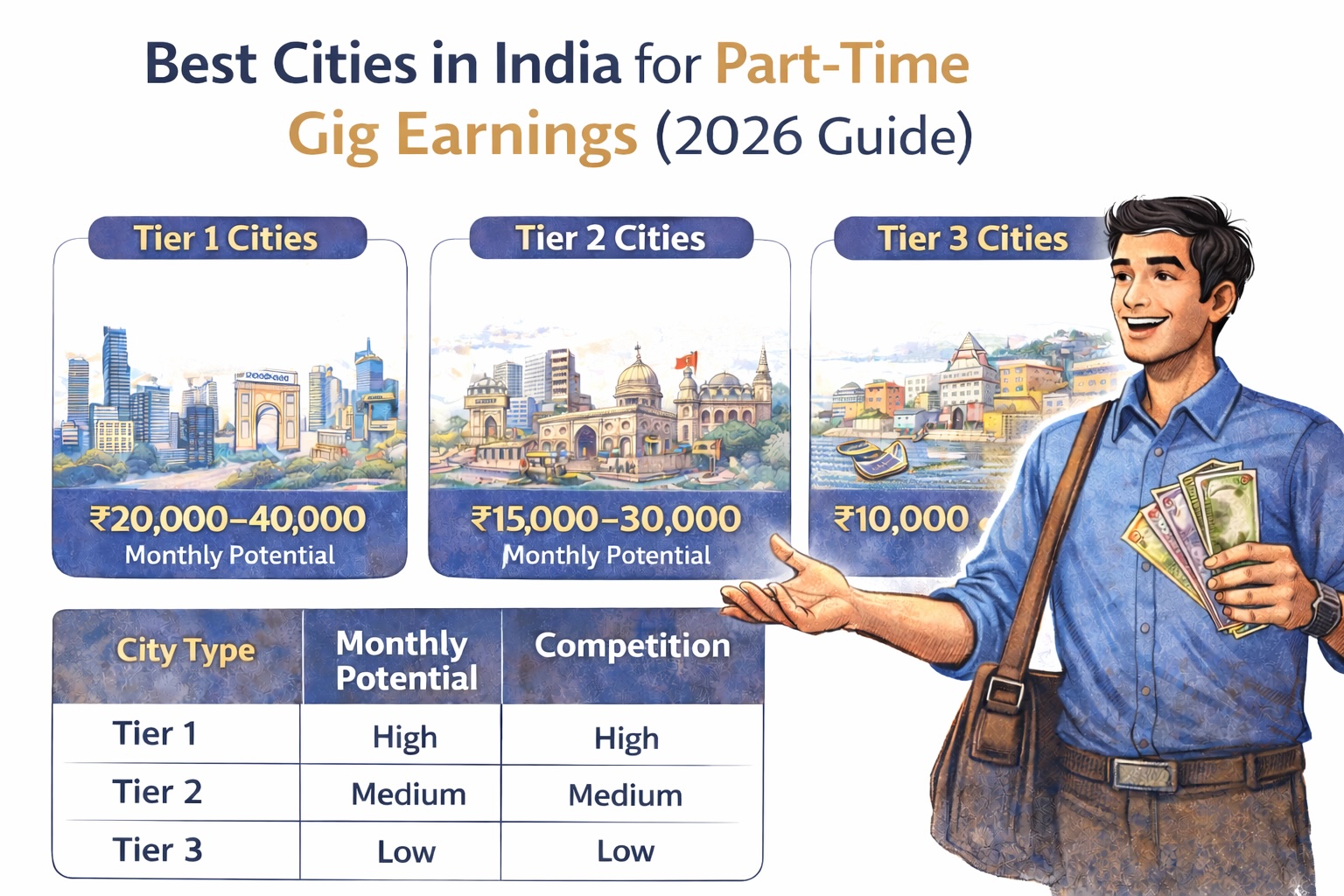
Gig income potential isn’t the same everywhere.
Some cities:
- Have more businesses
- More onboarding demand
- Higher payout rates
- Better digital adoption
If you’re looking to maximise gig earnings, geography matters.
Tier 1 Cities – Highest Earning Potential
Delhi NCR
- High merchant density
- Strong fintech & account opening demand
- Average gig income: ₹20,000–₹40,000/month (active users)
Mumbai
- Dense commercial clusters
- Premium onboarding gigs
- Strong weekend activation demand
Bangalore
- Tech-savvy audience
- High UPI & app onboarding activity
- Digital gig potential strong
Tier 2 Cities – Fastest Growing Gig Markets
Lucknow
- Expanding SME market
- High KYC & merchant onboarding demand
Jaipur
- Growing fintech penetration
- Balanced digital + field gig opportunities
Indore
- Rapid digital adoption
- High referral-based gig potential
Tier 3 Cities – Underrated Opportunity
Smaller cities often have:
- Less competition
- Higher conversion rates
- Strong demand for assisted onboarding
This makes them surprisingly profitable.
Earnings Snapshot by City Type
| City Type | Monthly Earning Potential | Competition |
|---|---|---|
| Tier 1 | ₹20k–₹40k | High |
| Tier 2 | ₹15k–₹30k | Medium |
| Tier 3 | ₹10k–₹25k | Low |
How to Maximise Earnings in Your City
- Focus on high-demand gigs
- Combine field + digital
- Stay consistent weekly
- Track conversion rate
The best city isn’t always the biggest city.
It’s the one where:
- Demand is rising
- Competition is manageable
- You’re consistent
Gig earnings are not random — they’re strategic.
Frequently Asked Questions (FAQs)
1. Which city in India offers the highest part-time gig earnings?
Tier 1 cities like Delhi NCR, Mumbai, and Bangalore typically offer the highest earning potential due to higher business density, fintech adoption, and onboarding demand. Active gig workers in these cities can earn ₹20,000–₹40,000 per month depending on consistency.
2. Can I earn well from gigs in Tier 2 cities?
Yes. Cities like Lucknow, Jaipur, Indore, and Bhopal are growing fast in digital adoption. While payouts per task may be slightly lower than Tier 1 cities, competition is also lower, making earnings of ₹15,000–₹30,000 realistic.
3. Are Tier 3 cities good for gig work?
Yes. Tier 3 cities often have:
- Less competition
- Higher conversion rates
- Strong demand for assisted onboarding
Consistent workers can earn ₹10,000–₹25,000 monthly.
4. Do gig payouts vary by city?
Yes. Payouts vary based on:
- Business density
- Demand for services
- Merchant onboarding activity
- Digital penetration
However, effort and consistency matter more than location alone.
5. Can students earn from gigs in smaller cities?
Yes. Students in Tier 2 and Tier 3 cities often perform well in:
- Referral-based gigs
- Digital onboarding tasks
- Local merchant activation
Gig work is especially suitable for flexible schedules.
6. Is competition higher in Tier 1 cities?
Yes. Tier 1 cities offer higher payouts but also have more gig workers. Success depends on:
- Speed
- Consistency
- Targeting high-demand projects
7. How can I maximise gig earnings in my city?
To increase income:
- Combine field + digital gigs
- Work consistently each week
- Focus on high-conversion tasks
- Track which gigs perform best locally
8. Does gig income depend only on location?
No. Location affects opportunity volume, but earnings mainly depend on:
- Hours invested
- Task selection
- Performance quality
- Conversion rate
9. Are part-time gigs sustainable long-term?
Yes, if treated professionally. Many workers use gig income as:
- A rent supplement
- Insurance buffer
- Emergency fund builder
- Side income for financial flexibility
10. How do I know which gigs are in demand in my city?
The easiest way is to check platforms like PickMyWork regularly. Demand often varies by:
- Campaign cycle
- Business partnerships
- Seasonal activity