
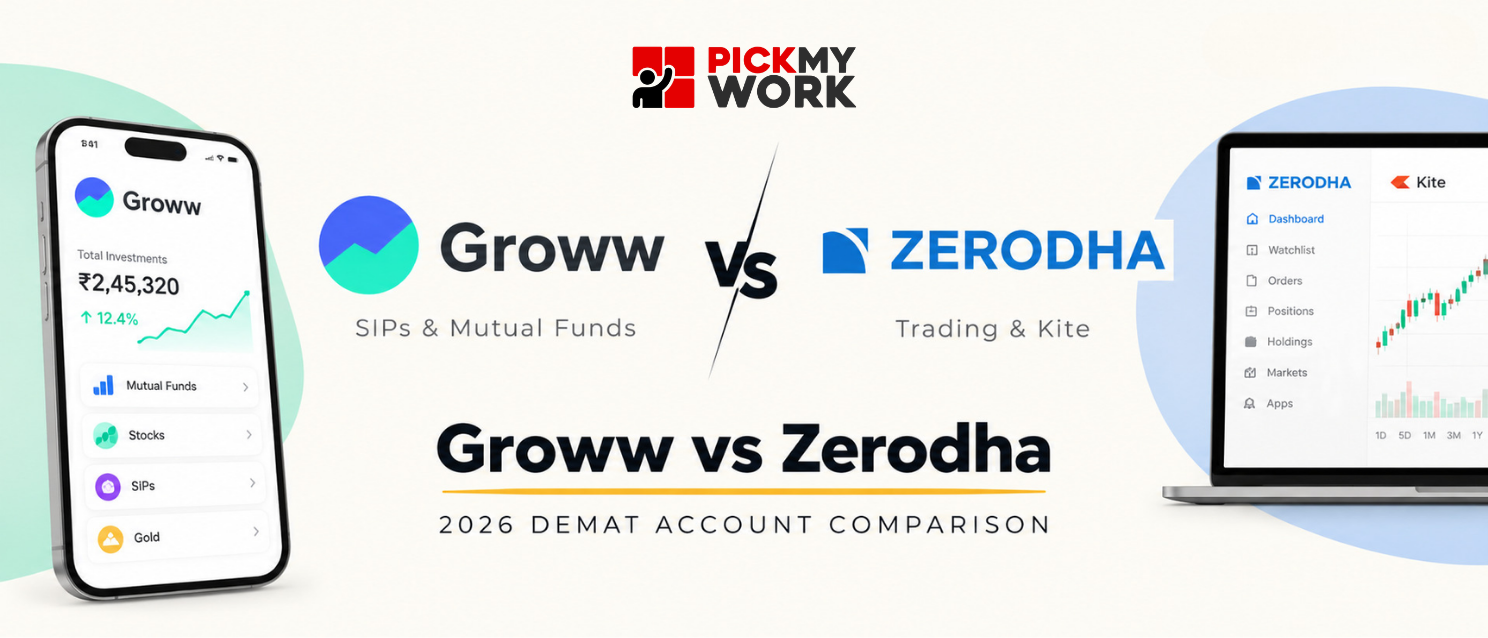

Demat Account Comparison 2026
Groww and Zerodha are the two most searched demat account platforms in India in 2026. Groww leads in app simplicity and mutual fund investing; Zerodha leads in active trader tools and education. This comparison covers account charges, brokerage fees, platform features, and which platform makes more sense depending on how you invest so you can make an informed decision before opening an account.
Groww vs Zerodha 2026: At a Glance
| Feature | Groww | Zerodha |
|---|---|---|
| Account Opening | Free | Free |
| Annual Maintenance (AMC) | Rs. 0 first year, then Rs. 50/month (CDSL) | Rs. 300/year + GST (CDSL) |
| Equity Delivery Brokerage | Zero | Zero |
| Intraday / F&O | 0.05% or Rs. 20, whichever is lower | 0.03% or Rs. 20, whichever is lower |
| Mutual Funds | Direct plans, zero commission | Direct plans via Coin (Rs. 50/month above Rs. 25,000) |
| Best For | Beginners, mutual fund investors, SIP users | Active traders, F&O users, serious equity investors |
| Education | In-app basics | Zerodha Varsity (free, comprehensive) |
Account Opening and Annual Charges
Both Groww and Zerodha offer free account opening in 2026. The difference shows up in annual maintenance charges (AMC). Groww waives AMC for the first year. From the second year, Groww charges Rs. 50 per month (Rs. 600 per year) for a CDSL demat account. Zerodha charges a flat Rs. 300 per year plus GST, making it slightly cheaper on AMC from year two. For someone who only wants to invest in mutual funds through Groww and does not hold stocks in the demat account, Groww’s AMC may not apply at all since mutual funds are held in statement of account form, not in demat.
Brokerage Fees Compared
For long-term equity investors who buy and hold stocks, both Groww and Zerodha charge zero brokerage on delivery trades. This makes the brokerage decision irrelevant for buy-and-hold investors. The difference matters only for intraday trading and futures and options. Groww charges 0.05% or Rs. 20 per order (whichever is lower) on intraday and F&O. Zerodha charges 0.03% or Rs. 20 per order. On a Rs. 50,000 intraday trade: Groww charges Rs. 20 (cap applies), Zerodha charges Rs. 15. The difference is small for occasional traders but adds up for high-frequency intraday users.
Mutual Fund Investing: Groww Wins for Simplicity
Groww is built around mutual fund investing. Direct plan mutual funds, SIP setup, fund comparisons, and portfolio tracking are seamlessly integrated into the Groww app with no additional charges. Zerodha offers mutual funds through its Coin platform, but Coin charges Rs. 50 per month for holdings above Rs. 25,000. For someone primarily investing in mutual funds, Groww is the more cost-effective and user-friendly choice in 2026. If mutual funds are secondary to your equity and derivatives activity, Zerodha’s Coin cost is a minor consideration.
Trading Platform: Zerodha Kite vs Groww App
Zerodha’s Kite platform is widely considered one of the best trading interfaces in India. It supports advanced charting, multiple order types, options chain analysis, and fast order execution. Serious equity and derivatives traders consistently prefer Zerodha Kite for its depth and speed. Groww’s platform is cleaner and more intuitive for beginners. It covers basic order types, portfolio tracking, and watchlists without overwhelming new investors with complexity. If you are just starting out or primarily doing SIPs and occasional stock purchases, Groww’s simplicity is an advantage. If you trade actively or use F&O, Zerodha Kite is the better tool.
Learning and Research
Zerodha Varsity is a free educational platform covering stock markets, technical analysis, fundamental analysis, derivatives, and personal finance from basics to advanced level. It is one of the most comprehensive free investing education resources available in India and is not limited to Zerodha customers. Groww offers in-app educational content suitable for beginners. For someone who wants to learn investing seriously while using their broker’s own resources, Zerodha has a clear advantage through Varsity.
Which Is Better for Beginners?
Groww is the better starting point for most first-time investors in India in 2026. The app is simpler, mutual fund investing is seamless, SIP setup takes under three minutes, and the learning curve is minimal. Zerodha is not difficult, but its range of tools and platform depth can feel overwhelming for someone who has never invested before. Open Groww if your primary goal is SIPs, mutual funds, and occasional stock purchases. Open Zerodha if you plan to trade intraday or use futures and options from early on.
Which Is Better for Active Traders?
Zerodha is the better choice for active traders. Kite’s charting tools, order types, and options chain view are built for speed and analysis. Zerodha also has the largest active client base among Indian brokers, which reflects the trust of the trading community. Groww has improved its trading features significantly in recent years but remains behind Zerodha for users who trade daily or manage complex derivatives positions. Zerodha’s slightly lower intraday brokerage (0.03% vs Groww’s 0.05%) adds up over many trades.
Verdict: Groww or Zerodha in 2026?
Choose Groww if…
- You are investing for the first time
- Mutual funds and SIPs are your primary investment
- You want the simplest possible app experience
- You plan to hold stocks long-term, not trade daily
Choose Zerodha if…
- You trade intraday or use futures and options
- You want advanced charting and order types
- You want to learn through Zerodha Varsity
- You are managing a large, active equity portfolio
Related Reads
- Lifetime Free Credit Cards in India 2026
- Best Credit Cards in India 2026 — Full Comparison
- Best UPI Credit Cards in India 2026
- Jio IPO 2026: Date, Price Band, and How to Apply
- Explore All Credit Cards on PickMyWork
Frequently Asked Questions
- Is Groww better than Zerodha for beginners in 2026?
Yes. Groww’s simpler interface, seamless SIP setup, and cleaner app experience make it the better choice for first-time investors. Zerodha is more suitable for active traders who need advanced tools. - Which has lower brokerage, Groww or Zerodha?
Both charge zero brokerage on equity delivery trades. For intraday and F&O, Zerodha charges 0.03% or Rs. 20 (whichever is lower) and Groww charges 0.05% or Rs. 20. Zerodha is slightly cheaper for active intraday traders. - Can I open both Groww and Zerodha accounts?
Yes. You can hold multiple demat accounts with different brokers simultaneously in India. Some investors maintain a Groww account for mutual funds and a Zerodha account for active equity trading. - Is Zerodha safe in 2026?
Yes. Zerodha is SEBI-registered, uses CDSL for demat custody, and is India’s largest stockbroker by active client count. Your securities are held with CDSL, not with Zerodha, which provides regulatory protection independent of the broker. - Which is better for SIP in 2026, Groww or Zerodha?
Groww is better for SIP in 2026. Groww supports direct plan mutual fund SIPs with no additional platform fee. Zerodha’s Coin platform charges Rs. 50 per month for mutual fund holdings above Rs. 25,000, making Groww the more cost-effective SIP platform.
Also searched for: Groww vs Zerodha 2026, best demat account India 2026, Groww vs Zerodha charges comparison, Zerodha Kite vs Groww app, Groww vs Zerodha for beginners India, best demat account for SIP India, Zerodha brokerage 2026, Groww brokerage charges 2026, Groww vs Zerodha mutual funds, which is safer Groww or Zerodha India.