
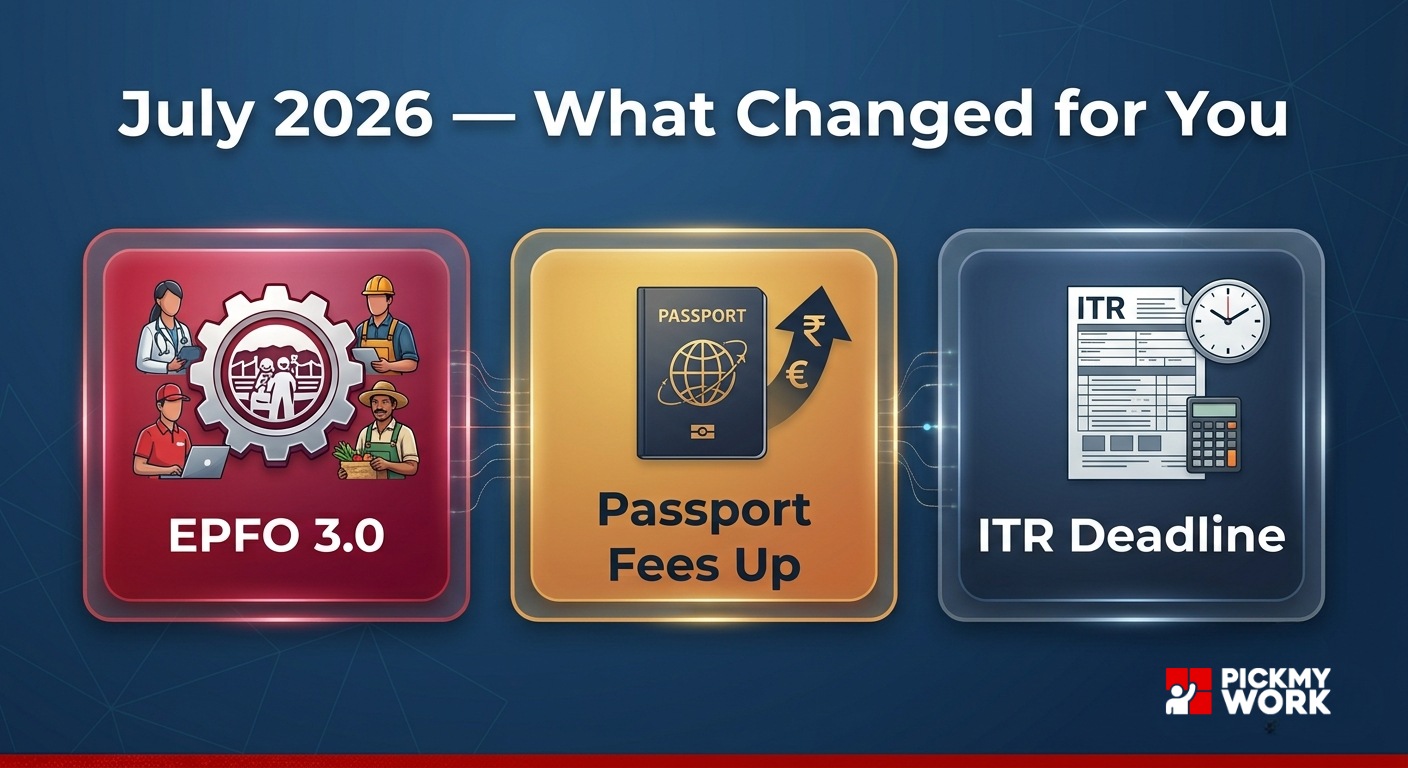

July 2026 is one of the most significant months for rule changes in India in recent years. The Employees’ Provident Fund Organisation (EPFO) implemented the new EPF Scheme 2026 under the Code on Social Security, replacing the 74-year-old EPF Scheme 1952. The Ministry of External Affairs revised passport fees for the first time in 14 years under the Passports (Amendment) Rules, 2026. The Income Tax Department introduced a staggered ITR deadline system for Assessment Year 2026-27, splitting the July 31 and August 31 deadlines by taxpayer category. And the Unique Identification Authority of India (UIDAI) made Aadhaar email updates free until December 31, 2026. If you are a salaried employee, a gig worker, a small business owner, or someone planning to travel, at least one of these changes directly affects you.
EPFO Changes in July 2026 — New EPF Scheme, EPFO 3.0, and 8.25% Interest
The Employees’ Provident Fund Organisation introduced the largest overhaul of India’s provident fund system since 1952, effective July 1, 2026. The new EPF Scheme 2026, notified under the Code on Social Security, 2020 by the Union Ministry of Labour and Employment, modernises membership, contributions, withdrawals, compliance, and fund administration across the board for over 9 crore active contributing members and approximately 34 crore total account holders.
- New EPF Scheme 2026 replaces the 1952 framework: The new scheme modernises several operational aspects and introduces a one-time amnesty mechanism allowing employers to voluntarily regularise historical compliance gaps and resolve long-pending disputes. The amnesty window runs from July 1 to October 31, 2026, with a nominal Rs. 100 damage fee per establishment instead of full penalties.
- EPFO 3.0 — UPI and ATM withdrawals rolling out in phases: EPFO 3.0 was approved by the Central Board of Trustees on October 13, 2025 and its rules came into effect from June 29, 2026. Once fully live, members will be able to withdraw up to 75% of their EPF balance through UPI and up to 50% through EPFO-issued ATM cards. The rollout is happening in phases with no confirmed nationwide launch date yet. Members should check the official EPFO portal at epfindia.gov.in or the UMANG app to confirm availability for their account. Complete KYC with Aadhaar, PAN, and a verified bank account is mandatory before these features become accessible.
- Auto-settlement limit raised from Rs. 1 lakh to Rs. 5 lakh: EPFO has raised the auto-settlement limit to Rs. 5 lakh from the earlier Rs. 1 lakh. Claims below this threshold are now processed automatically without manual or employer intervention, with 95% of claims settling within hours or minutes. This applies to eligible withdrawal claims with complete KYC.
- Withdrawal rules under the new scheme: For full exit events such as retirement, retrenchment, permanent disability, voluntary retirement, or permanent migration from India, members can withdraw their complete EPF balance. For partial withdrawals for purposes such as medical treatment, education, marriage, or housing, at least 25% of accumulated contributions must remain untouched. The EPFO portal automatically blocks 25% of total balance, with only 75% available for withdrawal under EPFO 3.0 once it goes live.
- 8.25% interest credited by July 15, 2026: EPFO credited over Rs. 1.44 lakh crore in annual interest at the rate of 8.25% for FY 2025-26 across approximately 34 crore subscriber accounts by July 15, 2026. Under the new upgraded system, interest that previously arrived in October or November has been credited as early as July, a significant improvement for members.
- Online services restored after upgrade: EPFO had temporarily suspended online services from June 26 to June 30, 2026 for a software upgrade and system migration. From July 1, all online services including PF balance check, claim filing, account transfer, e-passbook, employer portal, and UMANG app services were restored on the upgraded system.
Passport Fee Hike July 2026 — First Revision in 14 Years
The Ministry of External Affairs revised Indian passport fees for the first time since 2012, effective July 1, 2026, through the Passports (Amendment) Rules, 2026. The revision covers fresh applications, renewals, Tatkaal services, lost or damaged passport replacement, Police Clearance Certificates, and all other passport-linked services. Increases range from 60% to 75% across categories.
| Category | Old Fee | New Fee (from July 1) |
|---|---|---|
| 36-page adult passport (normal) | Rs. 1,500 | Rs. 2,500 |
| 60-page adult passport (normal) | Rs. 2,000 | Rs. 3,500 |
| 36-page adult passport (Tatkaal) | Rs. 3,500 | Rs. 5,000 |
| 60-page adult passport (Tatkaal) | Rs. 4,000 | Rs. 6,000 |
| 36-page minor passport (normal) | Rs. 1,000 | Rs. 1,750 |
| 36-page minor passport (Tatkaal) | Rs. 3,000 | Rs. 4,250 |
| Lost or damaged 36-page replacement | Rs. 3,000 | Rs. 5,000 |
| Police Clearance Certificate (PCC) | Rs. 500 | Rs. 750 |
Who gets a discount: A 10% discount on the normal fee applies to fresh passport applications (not renewals) for children up to 8 years old and senior citizens above 60. For applicants abroad, fresh 36-page passports under normal service now cost USD 125. Confirm the exact amount with your local Indian mission as rates depend on local currency conversions set by each mission.
ITR Filing Deadline July 2026 — New Staggered System for AY 2026-27
The Income Tax Department introduced a staggered deadline calendar for Assessment Year 2026-27 (income earned in FY 2025-26) through the Finance Act, 2026. For the first time, the deadline differs by taxpayer category rather than applying a single July 31 date to everyone. This is also the last filing season under the Income Tax Act, 1961 — from April 2026 onwards, returns will fall under the new Income Tax Act, 2025.
| Taxpayer Category | ITR Form | Deadline | Late Fee |
|---|---|---|---|
| Salaried, pensioners, individuals with salary and interest income | ITR-1, ITR-2 | July 31, 2026 | Up to Rs. 5,000 under Section 234F |
| Freelancers, consultants, professionals, small business owners, partners (no audit required) | ITR-3, ITR-4 | August 31, 2026 | Up to Rs. 5,000 under Section 234F |
| Businesses and individuals requiring tax audit | ITR-3, ITR-5, ITR-6 | October 31, 2026 | Up to Rs. 5,000 under Section 234F |
| Belated return (all categories) | All forms | December 31, 2026 | Up to Rs. 5,000 penalty applies |
| Revised return (if errors found after filing) | All forms | March 31, 2027 (extended from Dec 31) | No penalty for revision |
New TDS forms from July 31: Businesses filing TDS/TCS returns for Q1 of Tax Year 2026-27 must use new forms under the Income Tax Act, 2025. Form 138 replaces Form 24Q for salary TDS, Form 140 replaces Form 26Q for non-salary TDS, and Form 143 replaces Form 27EQ for TCS. All three are due by July 31, 2026.
Aadhaar Email Update Now Free Until December 31, 2026
The Unique Identification Authority of India (UIDAI) made email address updates in Aadhaar free of cost, available directly through the official Aadhaar App, confirmed in a Press Information Bureau release dated July 3, 2026. This free window runs until December 31, 2026. Update is available through the official Aadhaar mobile app only, not through agents or third-party portals. If your old email ID is linked to Aadhaar and is no longer active, or if you never linked an email at all, this is the window to fix it at no cost. A correct, active email address on Aadhaar is important for OTP alerts, government service access, and identity verification.
RBI New Rules — Protection Against Mis-selling from July 1, 2026
The Reserve Bank of India introduced new rules from July 1, 2026, strengthening customer protection against mis-sold financial products. If a customer is wrongly sold a financial product including insurance, mutual funds, or similar investment products without accurate disclosure of terms, risks, or suitability, they can now claim a full refund and compensation for financial loss. The rules are specifically designed to reduce cases where customers are sold products that do not match their needs or are not explained accurately at the point of sale.
What These July 2026 Changes Mean for PickMyWork Partners
Every change listed above creates a direct conversation opportunity for PickMyWork partners selling financial products.
- ITR deadline urgency: The July 31 ITR deadline creates a natural opening to talk about financial planning and earning side income. Gig workers who file ITR-4 now have until August 31, giving them an extra month. This is a good time to onboard new PickMyWork partners from the freelancer and gig worker community.
- RBI mis-selling rules: The new RBI protection rules actually strengthen the PickMyWork partner model. Partners earn only when customers complete a verified, eligible action. There is no pressure selling and no upfront payment required from the customer. This is exactly the kind of transparent, performance-based sales model the RBI rules are designed to encourage.
- Aadhaar update window: Many credit card and Demat account applications require a valid, active Aadhaar-linked mobile number and email. Helping customers update their Aadhaar email before applying removes a common friction point in the lead conversion process.
Related Reads
- ITR Filing for Freelancers and Gig Workers in India 2026
- Freelancing vs Full Time Job in India 2026
- How to Earn Money Online in India
- Best Credit Cards for Rs. 50,000 Salary in India 2026
- What Is a Demat Account and How to Open One in India 2026
Frequently Asked Questions — Major Changes July 2026 India
- What are the major rule changes in India from July 2026?
July 2026 brought five major rule changes for Indian citizens and workers. The new EPF Scheme 2026 replaced the 1952 framework under the Code on Social Security. EPFO 3.0 rules came into effect from June 29, 2026, with UPI and ATM withdrawals rolling out in phases. Indian passport fees were revised for the first time in 14 years under the Passports (Amendment) Rules, 2026. The Income Tax Department introduced staggered ITR deadlines with July 31 for salaried filers and August 31 for freelancers and business owners. UIDAI made Aadhaar email updates free until December 31, 2026. The RBI also introduced new customer protection rules against mis-sold financial products. - What is the new EPFO withdrawal rule in July 2026?
Under the new EPF Scheme 2026 and EPFO 3.0, once the withdrawal features go live, members will be able to withdraw up to 75% of their EPF balance through UPI and up to 50% through EPFO-issued ATM cards. The rollout is happening in phases with no confirmed nationwide date yet. The auto-settlement limit has been raised from Rs. 1 lakh to Rs. 5 lakh, with 95% of claims now processing automatically. For full exit events like retirement or retrenchment, complete balance withdrawal is permitted. For partial withdrawals, at least 25% of accumulated contributions must remain untouched. Complete KYC with Aadhaar, PAN, and a linked bank account is mandatory to access EPFO 3.0 features. - What is the new Indian passport fee from July 1, 2026?
From July 1, 2026, a standard 36-page adult passport (fresh or renewal, normal processing) costs Rs. 2,500, up from Rs. 1,500. A 60-page adult passport now costs Rs. 3,500 (up from Rs. 2,000). Tatkaal fees are Rs. 5,000 for 36 pages and Rs. 6,000 for 60 pages. A Police Clearance Certificate now costs Rs. 750 (up from Rs. 500). A 10% discount applies for fresh applications (not renewals) by children up to 8 years and senior citizens above 60. This is the first passport fee revision since 2012. - What is the ITR filing deadline for salaried employees in AY 2026-27?
Salaried employees, pensioners, and individuals filing ITR-1 or ITR-2 must file their income tax return for Assessment Year 2026-27 (FY 2025-26 income) by July 31, 2026. Freelancers, consultants, professionals, and small business owners filing ITR-3 or ITR-4 who do not require a tax audit have until August 31, 2026. Businesses requiring a tax audit have until October 31, 2026. Belated returns can be filed until December 31, 2026 with a late fee of up to Rs. 5,000 under Section 234F. Revised returns can now be filed until March 31, 2027, extended from the earlier December 31 deadline. - How to update Aadhaar email address for free in 2026?
UIDAI has removed the Rs. 75 fee for Aadhaar email updates from July 1 to December 31, 2026. To update your email address, download the official Aadhaar app, log in with your registered mobile number, and follow the email update process. Do not use third-party agents, unofficial websites, or unknown links. Only official UIDAI platforms are authorised for this update. - What is the EPF interest rate for FY 2025-26?
The EPFO declared an interest rate of 8.25% per annum for FY 2025-26, the same rate as the previous year. EPFO credited over Rs. 1.44 lakh crore in total interest across approximately 34 crore subscriber accounts by July 15, 2026. Under the upgraded system, interest that previously arrived in October or November has been accelerated to July. - Is EPFO 3.0 UPI withdrawal live in July 2026?
EPFO 3.0 rules came into effect from June 29, 2026, but the UPI and ATM withdrawal features are rolling out in phases with no confirmed nationwide launch date. Once live, members will be able to withdraw up to 75% of EPF balance via UPI and up to 50% via ATM. Members should check the official EPFO portal at epfindia.gov.in or the UMANG app to confirm whether the feature is available for their specific account. Complete KYC is mandatory to access these features when they become available.
Also searched for: EPFO new rules July 2026, EPF Scheme 2026 changes, EPFO 3.0 UPI withdrawal when live, passport fee hike July 2026 new rates, ITR filing last date AY 2026-27, ITR-1 ITR-2 ITR-3 deadline July August 2026, Aadhaar email update free July 2026, RBI mis-selling rules July 2026, EPF interest rate 2025-26, Code on Social Security 2020 effective date.