
Sales for financial services in India has never been more competitive or more costly. Banks, NBFCs, insurance companies, and fintechs are all chasing the same expanding customer base while facing the same structural problem: traditional sales teams are expensive to build, slow to scale, and difficult to manage across geographies. A full-time sales representative costs Rs. 40,000 to Rs. 80,000 per month in salary alone before training, management overhead, and attrition. And attrition in BFSI sales roles averages 25% to 40% annually in India. The organisations scaling fastest in financial product sales in 2026 are not building bigger internal teams. They are building smarter partner ecosystems.
Why Sales for Financial Services Is Uniquely Difficult to Scale
Financial products are not impulse purchases. A credit card, a Demat account, a savings product, or an insurance policy requires a customer to share personal financial information, trust the seller, complete a KYC process, and make a considered decision. This trust barrier means that financial product sales converts far better through personal networks and warm referrals than through cold outreach or digital advertising alone.
- Geography is the primary constraint: India’s real financial services growth opportunity is not in the metros where penetration is already high. It is in Tier 2, Tier 3, and semi-urban markets where digital-first brands cannot reach without feet on the ground. A centralised sales team based in Mumbai or Bangalore cannot cost-effectively serve Jhansi, Tirunelveli, or Siliguri.
- Trust is hyper-local: A customer in a smaller city is significantly more likely to open a credit card or Demat account when the person pitching it is someone from their own community — a neighbour, a local professional, or a familiar face. This is not a channel preference. It is how trust is built in India outside the metros.
- Compliance adds complexity: Every BFSI lead must be properly onboarded, KYC-verified, and confirmed before it counts as a completed sale. This requirement eliminates low-quality lead generation approaches and demands a model where payment is tied to verified completion, not just contact.
The Shift Happening Across BFSI Sales in India
India’s gig economy has grown to over 12 million workers as of FY2025, according to the Economic Survey 2025-26, and financial services is the category where gig-based distribution is proving most commercially effective. The reason is structural: gig partners are embedded in local communities, work within their own trust networks, and operate on mobile-first platforms that require no infrastructure investment from the brand.
The Salesforce State of Sales India 2026 report confirms this shift at the enterprise level: 94% of Indian sales professionals say partner selling is increasingly important for hitting revenue targets, and 84% of companies have already invested in this model. Partners have evolved from a supplementary channel into a primary growth engine for customer acquisition. In financial services specifically, this means brands are moving from fixed-cost internal sales teams to variable-cost partner networks where payment is triggered only by verified, completed outcomes.
What Financial Products Scale Best Through Gig Partner Sales
Not every financial product is equally suited to gig-based distribution. The products that convert most effectively through partner sales share three characteristics: they have a straightforward application process, they offer a clear and immediate benefit the partner can articulate, and they can be completed digitally without requiring the customer to visit a branch.
- Credit cards: The highest-volume category in gig financial sales. A partner identifies an eligible customer in their network, shares the application link, and guides them through a 10-minute digital KYC process. Credit cards have the shortest lead-to-verification cycle and the most clearly communicable benefits, making them the easiest pitch and the fastest payout for partners.
- Demat and trading accounts: With India adding over 4 crore new Demat accounts in FY2024-25, per SEBI data, the growth curve is steep and the target audience is broad. Partners in urban and semi-urban markets can identify first-time investors in their networks and complete onboarding entirely through the broker’s app.
- Savings accounts and banking products: New-to-bank customer acquisition is one of the most consistent categories for partner sales in Tier 2 and Tier 3 markets, where digital-first banks and small finance banks are actively expanding. A partner with local community roots can convert customers who would never respond to a cold call or a digital ad.
- Insurance products: Term insurance and health insurance onboarding through gig partners is an emerging category. The trust requirement is higher and the sales cycle is longer, but partners who operate within strong local networks convert at meaningful rates for the right insurance products at accessible premium levels.
How PickMyWork Helps Financial Services Brands Scale Sales
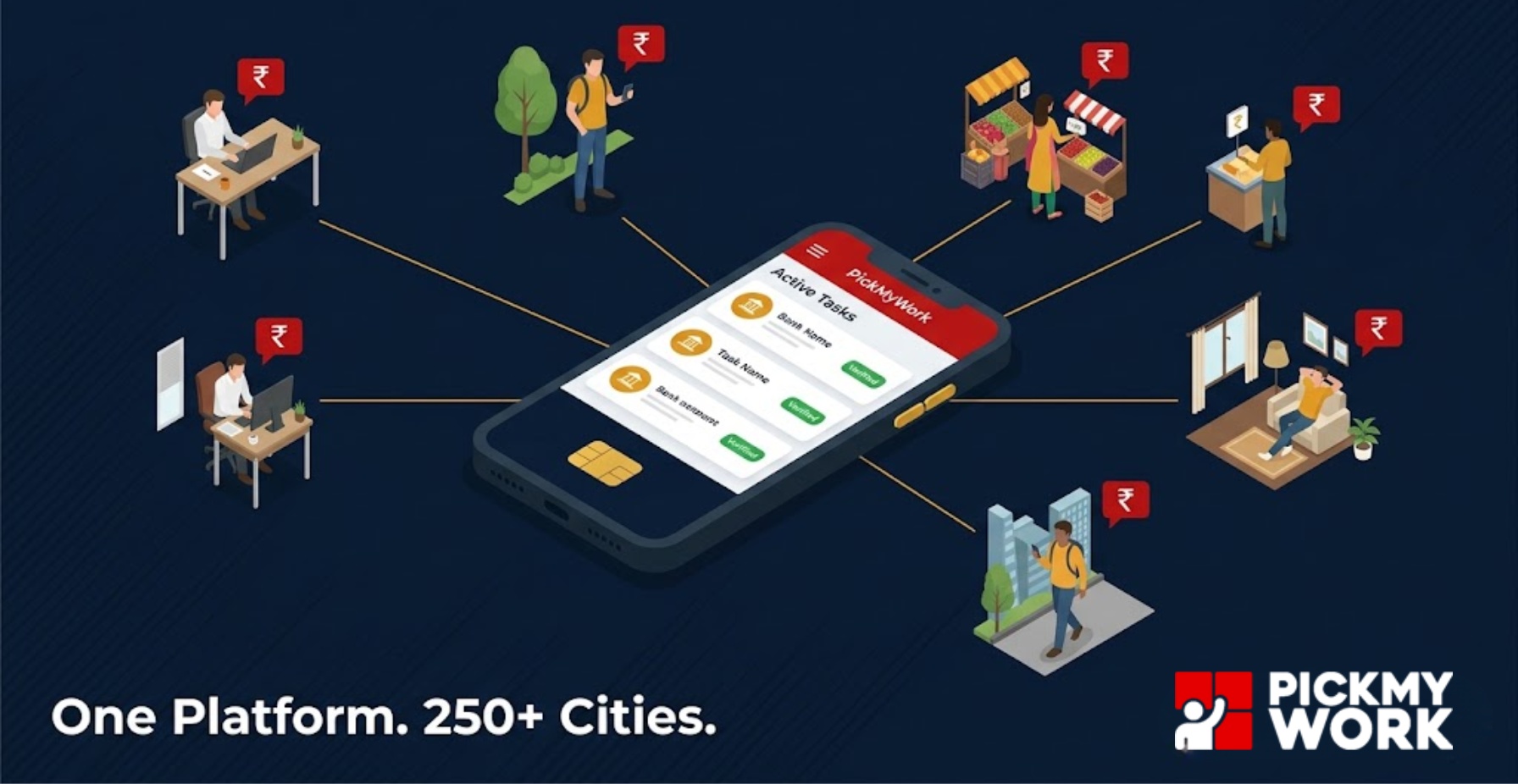
PickMyWork is India’s structured gig sales platform for financial services brands. Brands including HDFC Bank, SBI, Axis Bank, IDFC FIRST Bank, AU Small Finance Bank, AngelOne, Motilal Oswal, and others use PickMyWork to run last-mile financial product sales through a verified network of gig partners across India, without building or managing a direct sales force.
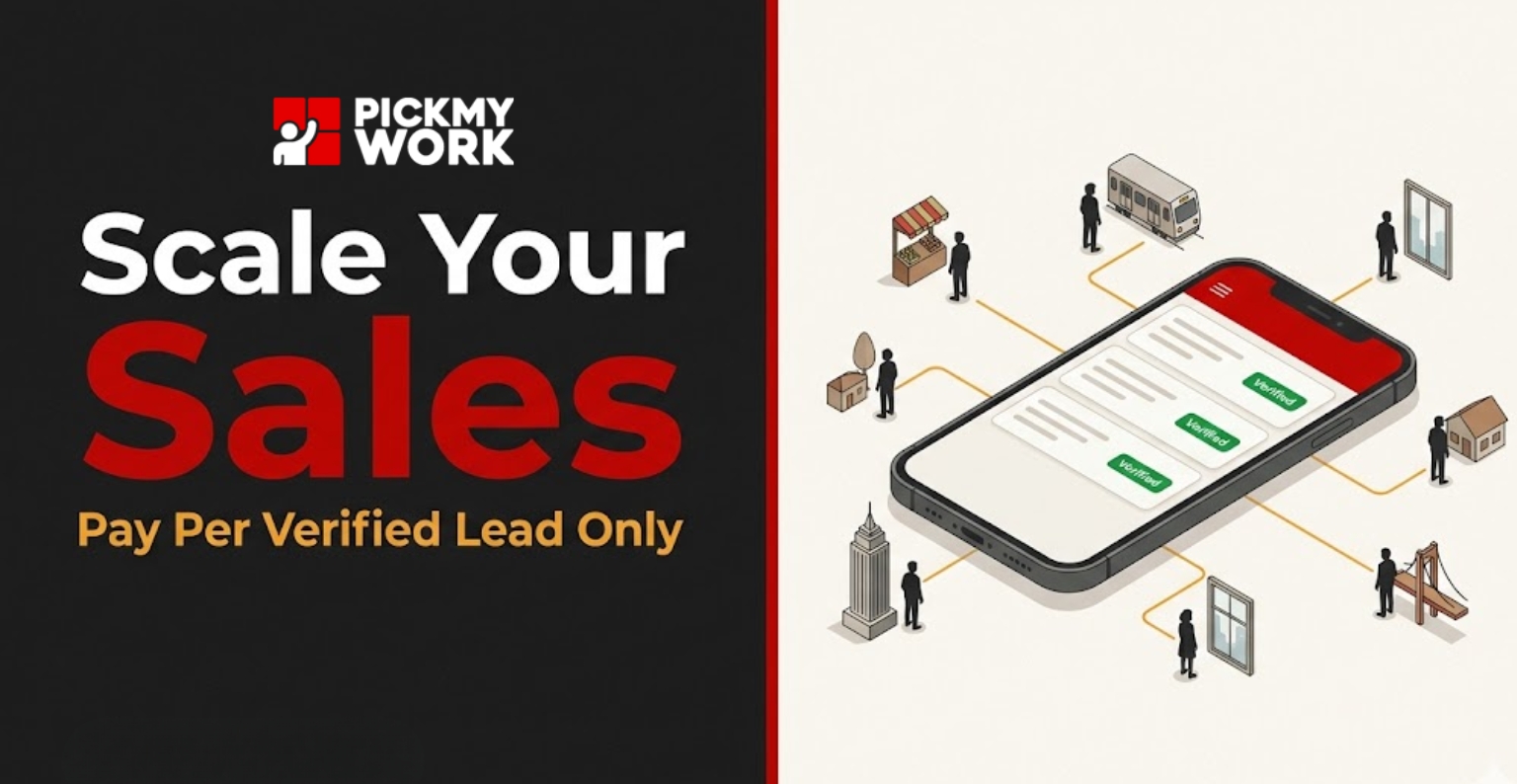
- Pay per verified lead only: Brands pay PickMyWork only when a lead is verified and completed — a credit card activated, a Demat account opened, a savings account funded. Zero fixed salary cost. Zero recruitment overhead. The entire commercial model is performance-based.
- Weekly reconciliation and payouts: PickMyWork settles with partners every Thursday. Brands receive weekly reconciliation reports on leads verified, leads pending, and leads rejected with reasons. Full transparency across the sales pipeline without managing it internally.
- Faster time to market than any internal build: Setting up an internal sales team in a new geography takes 3 to 6 months. Launching a PickMyWork campaign in a new city or state takes days. For brands entering new markets or pushing new product launches, this speed advantage is commercially significant.
PickMyWork offers four distinct service lines for financial services brands:
- Customer Acquisition: Targeted, trained partners who onboard verified customers for credit cards, Demat accounts, savings accounts, and insurance products.
- Merchant Acquisition: Physical, on-ground merchant onboarding for payment products, lending platforms, and fintech apps — real merchants, verifiable activations.
- User Activation: Beyond acquisition, PickMyWork drives repeated transactions and active usage — ensuring installed apps become daily-active users, not dormant installs.
- Audits: Rigorous, rapid field audits to verify merchant presence, product placement, and on-ground compliance across geographies.
Sales for Financial Services: The Case for a Partner-First Model
The financial services brands that will win customer acquisition in India over the next three years are not those with the largest internal sales teams. They are the ones that build the most effective partner ecosystems, rooted in local communities, operating at variable cost, and converting at scale. The gig economy has created a distribution layer in India that did not exist five years ago — and the BFSI sector is only beginning to use it at its full potential.
If your brand is looking to scale sales for financial services products without the fixed cost and management complexity of an internal team, PickMyWork’s partner model is built for exactly this problem. Talk to us.
Related Reads
- How to Earn Money Online in India
- What Is a Demat Account? How It Works and How to Open One in India 2026
- Best Credit Cards for Rs. 50,000 Salary in India 2026
- ITR Filing for Freelancers and Gig Workers in India 2026
- Freelancing vs Full Time Job in India 2026
- All Credit Cards Available on PickMyWork
Frequently Asked Questions About Sales for Financial Services
- What is the most effective way to scale sales for financial services in India?
The most effective model for scaling financial services sales in India in 2026 is a gig-based partner network operating on a pay-per-verified-lead structure. This model eliminates fixed salary costs, reaches Tier 2 and Tier 3 markets through local trust networks, and converts at higher rates than cold outreach because partners sell within their own communities. Platforms like PickMyWork provide the infrastructure, partner network, compliance framework, and reconciliation system required to run this model without building it internally. - Which financial products work best for gig-based partner sales?
Credit cards, Demat accounts, savings accounts, and entry-level insurance products convert most effectively through gig partner distribution. These products have short application cycles, can be completed digitally, and have clearly communicable benefits that partners can explain within their networks. Products with longer decision cycles or complex eligibility requirements are less suited to this model without additional partner training investment. - How does a pay-per-lead model work for financial services brands?
In a pay-per-verified-lead model, the brand pays only when a customer completes a defined action — a credit card activated, a Demat account opened, or a savings account funded — and the lead is verified by the bank or issuer. PickMyWork pays partners every Thursday for leads verified before that date. Brands are invoiced based on verified completions, not on contacts generated, applications submitted, or any earlier stage of the funnel. - What is the difference between BFSI BPO outsourcing and gig-based sales distribution?
BFSI BPO outsourcing typically refers to delegating back-office functions — KYC processing, customer service, fraud detection, loan servicing — to a large third-party provider with dedicated staff. Gig-based sales distribution refers specifically to front-end customer acquisition, where independent gig partners use their own networks to onboard new customers for financial products and earn commissions per completed task. PickMyWork operates in the gig-based sales distribution model, not back-office BPO. - How quickly can a financial services brand launch a sales campaign through PickMyWork?
A new campaign on PickMyWork can go live within days of onboarding, compared to 3 to 6 months required to set up an internal sales team in a new market. The partner network is already active and trained on financial product categories. Brand-specific training materials are added to the platform and partners begin picking up tasks immediately once the campaign is live and compliance requirements are confirmed. - How does PickMyWork ensure compliance in financial services sales?
PickMyWork structures every financial product task with clear eligibility rules, required KYC steps, and verification checkpoints aligned to the issuing bank or brand’s requirements. Partners complete only the steps required for a valid, compliant lead. Brands receive verified customer data that has passed the issuer’s activation or onboarding check — not raw leads that require further qualification or carry compliance risk.
Also searched for: BFSI customer acquisition India 2026, financial product sales outsourcing India, gig sales distribution financial services, pay per lead BFSI India, credit card sales outsourcing India, last mile financial services distribution India, sales outsourcing for banks India, NBFC customer acquisition strategy India, fintech sales partner model India, scale financial services sales without hiring.